



Header: Marco Zorzanello
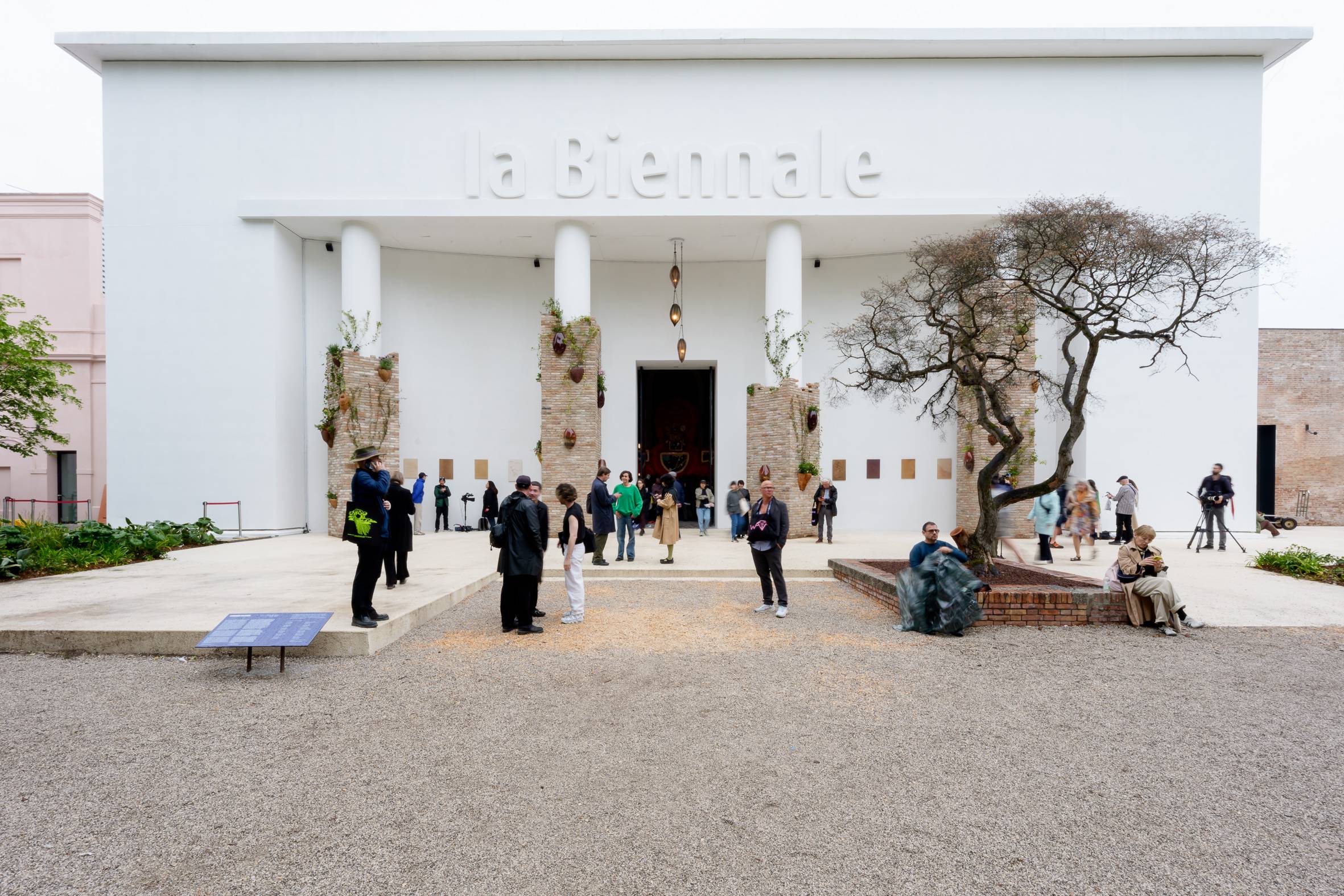
The 61st International Art Exhibition of La Biennale di Venezia is finally here and will be open from the 9th of May until the 22nd of November. Titled “In Minor Keys”, the exhibition takes place across the Giardini, the Arsenale, Forte Marghera and other famous venues in Venice.

As the two main sites, the Giardini brings together the long history of the Biennale and the architecture of its national pavilions, while the Arsenale offers a different setting, shaped by the length and scale of Venice’s former shipbuilding complex and its large industrial spaces. Beyond the two main sites, 31 official Collateral Events held in palazzi, foundations, cultural spaces and other venues take the Biennale into other parts of Venice.

Photo credit: Marco Zorzanello

Photo credit: Aguirre y Otegui

Photo credit: Eshetu Theo
Paying respects to Koyo Kouoh
This edition is inseparable from the late Koyo Kouoh, who had already defined its theoretical framework, selected the artists and works, chosen the catalogue contributors, developed the graphic identity and planned the exhibition architecture before her death in May 2025. The exhibition is now being completed by the team she appointed. Gabe Beckhurst Feijoo, Marie Hélène Pereira and Rasha Salti are working as advisors, with Siddhartha Mitter as editor-in-chief and Rory Tsapayi as research assistant.

Photo credit: Mehdi Benkler
Kouoh’s title, “In Minor Keys”, is inspired by music as a way to set the tone of the exhibition. It moves away from a loud, funky register and into quieter settings: blues, lament, whisper, improvisation, small islands, gardens, courtyards and oases. The exhibition gives space to listening, rest, repair, spirituality, collective work and sensibility having been built not around spectacle, but around ways of continuing through crisis. Art is presented as part of that process, a means of holding life together while pressure remains around it.

Photo credit: Mirjam Kluka

Photo credit: Mirjam Kluka
The exhibitions and their many references
The Biennale is organised around several recurring currents: “Shrines”, “Procession”, “Schools” and “Rest”. Literary and intellectual references can also be found throughout, including Toni Morrison’s “Beloved”, Gabriel García Márquez’s “One Hundred Years of Solitude”, Édouard Glissant, Patrick Chamoiseau and James Baldwin. Through these references, the event turns towards haunted histories, small-island thoughts, jazz, relation and repair. The main exhibition brings together 110 invited participants, including individual artists, duos, collectives and organisations, all of which were selected by Kouoh through resonance and affinity.

Photo credit: Andrea Avezzu

Photo credit: Luca Zambelli

Photo credit: Luca Zambelli
Two figures can’t be missed on the “Shrines” current: Issa Samb and Beverly Buchanan. Samb, the Senegalese artist, poet, playwright and co-founder of Laboratoire Agit’Art, was considered an important reference for Kouoh. Buchanan brings a different body of work, shaped by land art, public sculpture, place, memory and landscapes marked by history. “Procession” runs through carnival, Afro-Atlantic gatherings and collective movement. Artists connected to this current include Big Chief Demond Melancon, Nick Cave, Alvaro Barrington, Daniel Lind-Ramos and Ebony G. Patterson.
The “Schools” current looks at artist-led institutions, with six guests being Denniston Hill, blaxTARLINES KUMASI, G.A.S. Foundation, lugar a dudas, Nairobi Contemporary Art Institute and RAW Material Company. “Rest” introduces works that ask for slower attention, with the artists linked to this current including Mohammed Z. Rahman, Khaled Sabsabi, Cauleen Smith, Kader Attia, Laurie Anderson, Pauline Oliveros, Manuel Mathieu, Tsai Ming-liang, Éric Baudelaire, Manuel Mathieu, Tsai Ming-liang, Éric Baudelaire, Nicholas Hlobo, Dan Lie, Guadalupe Maravilla, and Himali Singh Soin with David Soin Tappeser.

Photo credit: Luca Zambelli

Photo credit: Luca Zambelli

Photo credit: Luca Zambelli
Gardens, courtyards and oases form another layer of the exhibition, bringing together work from Creole gardens, land, plants, water, non-human life and spaces of self-sufficiency. The artists named in this section include Ayrson Heráclito, Edouard Duval-Carrié, Wangechi Mutu, Maria Magdalena Campos-Pons with Kamaal Malak, Werewere Liking, Florence Lazar, Otobong Nkanga, Sabian Baumann, Theo Eshetu, Carolina Caycedo, Carsten Höller and Sandra Knecht.
The exhibition design is by Wolff Architects, based in Cape Town, who use thresholds as points of passage between groups of works and between the spaces of individual artists. The graphic identity and catalogue design are by Clarissa Herbst with Alex Sonderegger, with their work referring to komorebi, the Japanese word for light passing through leaves.

Photo credit: Luca Zambelli

Photo credit: Luca Zambelli

Photo credit: Holobo Nicholas
Music and performances
The performance programme runs from the 6th to the 11th of May across the Giardini and the Arsenale locations. Big Chief Demond Melancon’s “Poetry Caravan” refers to Kouoh’s 1999 journey with nine African poets from Dakar to Timbuktu. Maria Magdalena Campos-Pons and Kamaal Malak present a performance using sound, scent, painting, bass frequencies and bodily sensations. Guadalupe Maravilla’s “Sound Meditation Ceremony – Dedicated to the Cancer Community” uses gongs, voice and percussion as part of a collective sound ceremony. Hagar Ophir’s “Bound with the Living: Gathering in Venice” works with objects connected to displacement, uprooted lives and colonial violence. Other performances include Clarissa Herbst and Dominique Rust’s Parfumerie DJ set with DJ styropor, and Uriel Orlow’s ambulatory plant-reading work, “Reverie of Collective Walkers (Reading to Plants)”.

Photo credit: Ramos Daniel

Photo credit: Marco Zorzanello

Photo credit: Marco Zorzanello
Challenges in the background
Several pavilions are now linked to political disputes, as Russia’s return has been criticised because of the war in Ukraine, with opponents seeing it as a form of cultural normalisation. The Biennale president has defended the decision, saying the institution is “not a court”. Israel’s pavilion has also drawn criticism because of the war in Gaza, following boycott calls from artists, curators and cultural workers. South Africa’s pavilion has become another censorship case. Gabrielle Goliath’s work was reportedly blocked after political objections, including over a section honouring the Palestinian poet Hiba Abu Nada, who was killed in an Israeli airstrike. The official pavilion is expected to remain empty, while Goliath’s work is being shown independently. Australia has faced its own dispute since artist Khaled Sabsabi and curator Michael Dagostino were first dropped from the pavilion, then brought back after backlash, resignations and an independent review.

Photo credit: Marco Zorzanello

Photo credit: Marco Zorzanello

Photo credit: Marco Zorzanello
The awards structure changed shortly before the opening since the International Jury, made up of Solange Farkas, Zoe Butt, Elvira Dyangani Ose, Marta Kuzma and Giovanna Zapperi, resigned on the 30th of April, 2026. The resignation followed a dispute over prize eligibility for artists from countries whose leaders face charges at the International Criminal Court, a question that indirectly involved Russia and Israel.
Across the national pavilions, design is joined by arguments over war, state power, censorship and representation. So far, the Biennale has maintained its position on openness, dialogue, artistic freedom and the rejection of censorship, but due to countless changes, the awards ceremony has been moved from the 9th of May to the 22nd of November.

Photo credit: Marco Zorzanello

Photo credit: Jacopo Salvi

Photo credit: Jacopo Salvi
“In Minor Keys” opens as a posthumous exhibition, shaped by Koyo Kouoh’s work. Around it, the national pavilions bring disputes over war, state representation, sanctions, censorship and awards. These two things meet in Venice: an exhibition built around quieter forms of attention and a political setting that remains unsettled. In the end, Kouoh’s vision for the role of Art in a crisis came true.


