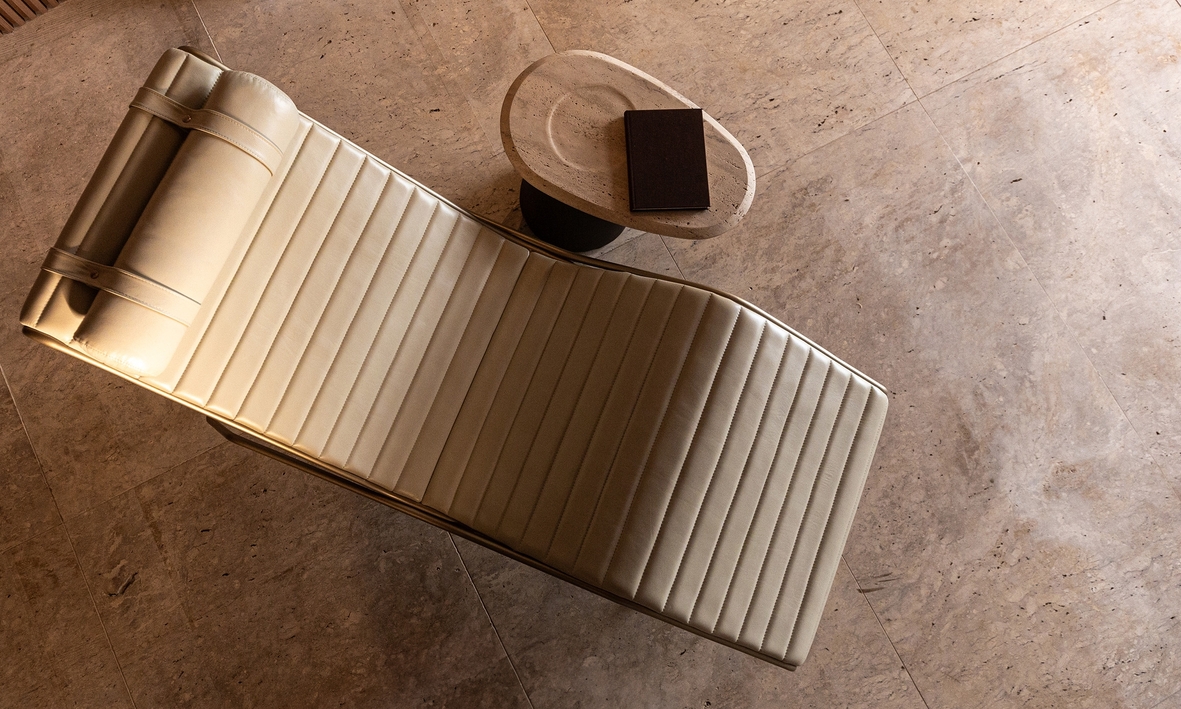
Header: Chaise Longue Aor by Choque Design, photo by agencia 020
By the end of the year, it’s always incredible to look back to our favourite furniture designs and notice the main themes and trends of the year. 2025 stood out for a very specific theme: high-quality pieces that are meant to last. At a time when both designers and buyers seem tired of “fast-fashion” furniture that doesn’t hold up and ends up being replaced far too quickly, more conscious approaches have had real support this year.
This top five was pulled together to reflect this theme, so you’ll be presented with a selection of strong forms, mixes of comfort and function, and love for tradition and culture.
Lambda Table by Giuseppe Bavuso X Rimadesio
Rimadesio’s 2025 collection, designed by Giuseppe Bavuso, was put together to give interiors a more consistent look, and the Lambda table was presented as the spotlight of that lineup. It ends up in this top five because it sums up a lot of what showed up in furniture this year: one strong shape, a lot of attention to finish, and a clear attempt to make different items feel like they belong to the same “family” without looking identical.
The base can be considered the very beginning of the design, having been built from two parts shaped to look like folded sheets of paper. These rise and meet each other in the middle, forming a silhouette that brings one’s mind to the Greek letter lambda. Even though the objective was lightness, the table is described as being made to stay very stable, using steel and wood to achieve such quality. Regarding the surface, the table comes in single-material versions using marble, wood, or the Terrae finish, which gets its brushed texture from natural powders applied by hand, and a thick lacquered glass top option in glossy or matt to complete the look.
Aor Chaise by Choque Design
Choque Design’s Chaise Longue Aor was designed as a new take on personal rest space, being pitched as the perfect piece for when you want to pause, read, or switch off for a bit. Designed by Dimitri Lociks and Choque Design’s creative team, its name comes from “aorist”, an ancient Greek verb tense that describes an action without tying it to a specific time. In this top five, it represents those pieces that try to achieve more than just looking good in a room, those that offer functionality and comfort in style.
The Aor is slim and built around the human body, with an anatomical backrest intended to support the back and spine and a headrest that can be moved around to suit different body types. It has a cantilevered structure that makes the chair appear to float and is made of a single piece of bent stainless steel paired with fibreglass. Its setup creates an open space inside the chair, which is meant to hold things like books or a tablet. Regarding inspiration, the designers point to Brazilian modernism in the flowing curves, referencing classic designs from the 60s and 70s.
RONDIN by Arnaud Lapierre
For its reception area, the French Ministry of Culture chose to include a new bench by Arnaud Lapierre, his bench-sculpture RONDIN. It’s a large bench-and-carpet hybrid (5 x 4.8 metres) that can be found right in the centre of the reception, letting visitors know that the traditional ideas (in this case, lines of chairs or a sofa) are continuously being contested and expanded by the Ministry. The peace itself is a cylinder, and its goal is rather ambitious: to invite people to try different ways of sitting rather than defaulting to the usual posture, which is exactly why it made the list.
RONDIN is made of wood and fabric, as wooden cylinders are set on a circular carpet that’s five metres across. The cylinder is covered in biosourced soy foam and finished with bog oak plugs, while the interior is stainless steel. RONDIN was produced by Atelier de Recherche et de Création (ARC) at the Mobilier National with the Robert Four Manufacture, and its colours and finishes are inspired by “The Triumph of Love by the Gods”, a recently restored 18th-century fresco by Antoine Coypel. The fresco’s ochres and blues were reworked into tile-like carpet patterns, and the link to the painting is better noticed when one looks at the piece from above.
Biscuit Armchair by WOWIN.UA
The Biscuit armchair was designed by WOWIN.UA for a collection built around softness, volume, and rounded forms with small, playful details. It makes the top five because it represents a theme that kept showing up this year: furniture that focuses on big, rounded upholstery and a minimalistic shape rather than lots of separate components.
The designers describe the chair as one continuous form, with the seat, back, and arms seemingly flowing around a single volume. The inspiration? Sweet pastries. From the side, the chair is described as compact and low, as it sits slightly off the floor on ball-shaped legs tucked under the frame, which can be easy to miss depending on where you’re standing. It’s fully upholstered in a soft, matte fabric, with generous cushions designed to hold their shape without being too rigid.
Bilro Coffee Table by Artífice Atelier
The Bilro Coffee Table, designed by Artífice Atelier in Brazil, is based on the form and construction of the atabaque, a hand drum used in Afro-Brazilian religious practices including Candomblé and Umbanda. It made the top five because of the vision and inspiration behind it, as one of the main themes of 2025 was furniture design that acknowledges traditions and cultural references. Through this theme, designers are able to bring attention to cultures that might be disappearing by having these thoughtful pieces added to the homes of people from all over the world.
The table’s shape is that of a drum, with its tall, slightly tapering curve defining the whole design. Made in solid wood with no ornaments, it uses stretched leather as a tabletop, another clear draw from the traditional instrument. The leather is fixed with a system of wooden pins, called bilros, which are strung with cotton cords.
Taken together, these five pieces make 2025 feel like a year where furniture got a bit more personal again. Now we must look forward and dream about what comes next. If this year was full, the question for 2026 is which of these design approaches deserves more space: more work that respects heritage? More experiments with sculptural forms? Or something else entirely? And just as important, what should be left behind if we’re serious about furniture that people will actually use for years to come?