
At first glance, Harvest Circuit feels like an ambitious urban farming concept. Look closer, and it reveals itself as a full-blown system where food, people, waste, energy, and shared space are all part of the same daily rhythm. The project, created by Ho Sin Chang from Chung Yuan Christian University in Taiwan, earned her the title of Emerging Landscape Architect of the Year at the BLT Built Design Awards for good reason.
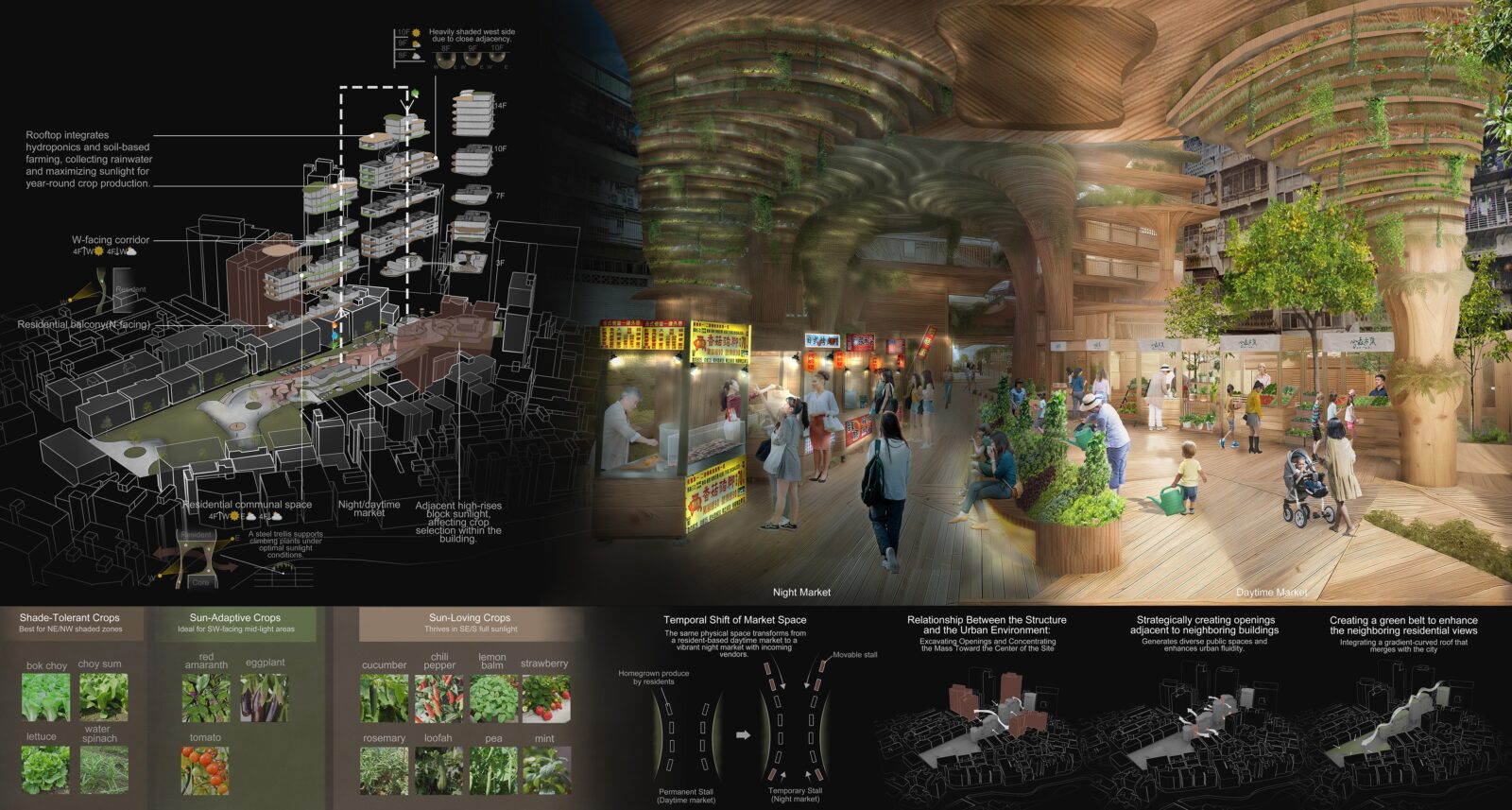
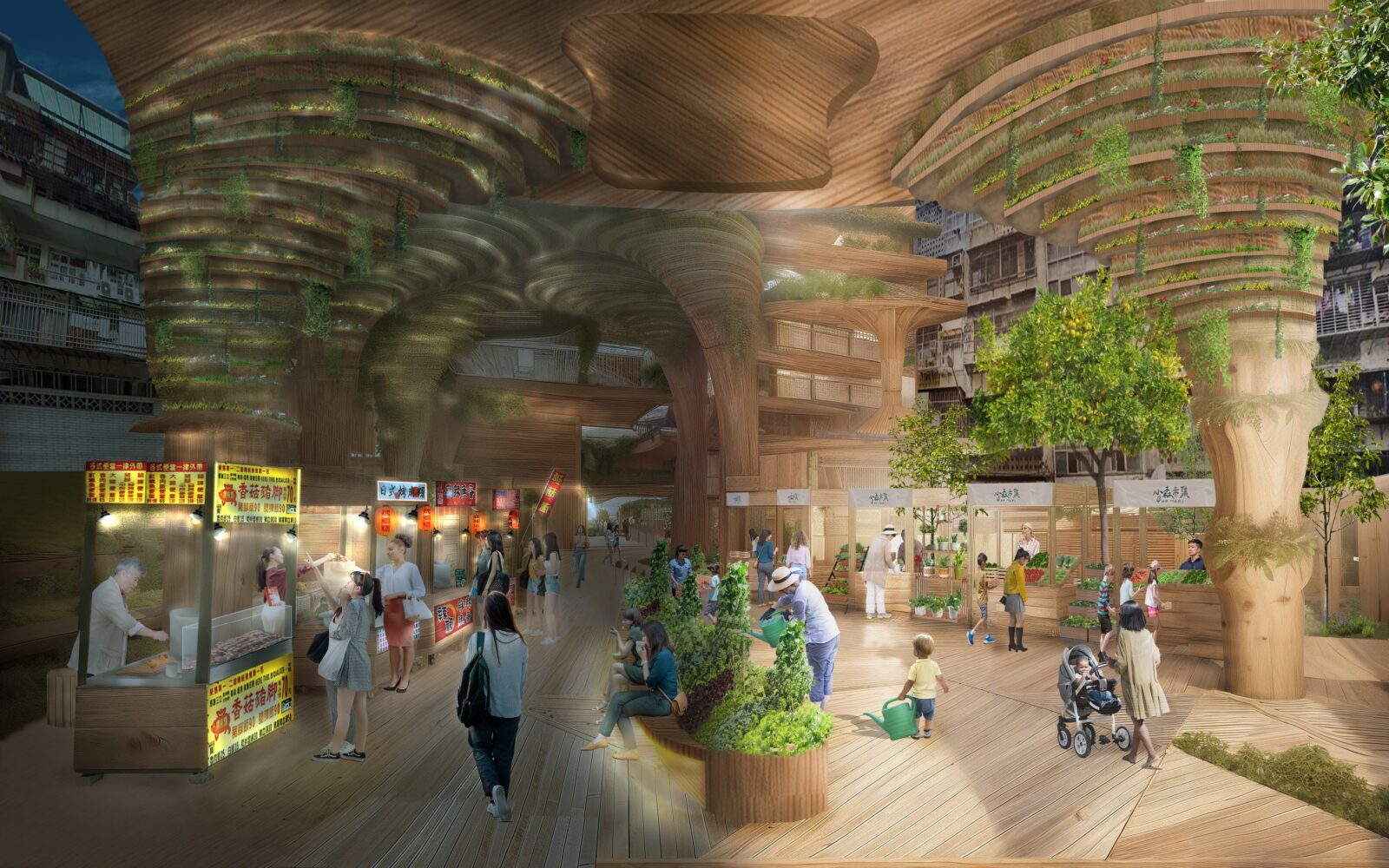
Instead of treating sustainability as an add-on, Harvest Circuit builds a circular economy directly into a dense urban structure. A market on the ground floor shifts from daytime produce sales to a night market after dark. Above it, shared courtyards and vertical farms become part of everyday life. On the roof, hydroponics, rainwater harvesting, and composting quietly run the system in the background. Market waste feeds the farm, the farm feeds the market, and the building functions as one continuous loop.
What makes the project especially compelling is how naturally it connects infrastructure with community, as growing food, sharing tools, composting, cooking, and trading all happen within the same architectural framework. It is a project that doesn’t just talk about sustainability but designs it into daily habits. We spoke with Ho Sin Chang about how Harvest Circuit came to life, the challenges of designing a closed-loop system as a student, and what this recognition means as she steps into her career.

Can you tell us a bit about your background and how you first became interested in landscape architecture and topics like urban farming and circular systems?
As an architecture student from Taiwan, I’ve always been intrigued by how spatial design can shape social relationships and ecological systems. My interest in landscape architecture grew from exploring how cities can be reimagined as productive and sustainable environments. Urban farming and circular systems, in particular, captivated me because they address urban issues holistically by combining food production, resource reuse, and community building.
What is the vision behind Harvest Circuit, and how did the project first come to you as an idea or problem you wanted to solve?
Harvest Circuit began with a question: how can we reintegrate nature into high-density cities in a way that goes beyond green decoration? I wanted to address the fragmentation between food systems, public life, and resource waste in cities. The vision was to create a hybrid infrastructure that not only produces food but also fosters circularity and social interaction—reshaping how urban spaces function at multiple levels.
How does Harvest Circuit practically integrate urban farming into a dense urban structure to improve ecology and strengthen community ties, and what kinds of interactions between residents and the farms do you imagine day to day?
The design incorporates urban farming across different vertical layers, from balconies and façades to rooftops, ensuring it’s embedded in everyday routines. Residents grow their own produce, exchange food, compost together, and use shared farming tools. These interactions promote ecological awareness and create stronger neighbourhood bonds through a sense of shared purpose.
How does the night market culture support the project, and in what ways can it help generate a circular economy through shared spaces, shared resources and more sustainable habits?
Night markets, a vibrant part of Asian urban life, are reimagined here as engines of circularity. Food scraps and waste heat from vendors are recycled into compost and energy for farming. In return, the urban farm supplies fresh produce back to the market. The market space also serves as a social and economic hub, encouraging sustainable habits through informal education and shared resource use.
How did you organise the layout, from the daytime/night market on the ground floor to the vertical farms and courtyards in the middle and the rooftop farm above, and how do these different levels work together to make the project function as a single system?
The layout is organised as a vertical loop. The ground floor hosts daytime produce sales and transforms into a night market. The middle floors contain shared kitchens, vertical green walls, and adaptive living units. The rooftop integrates hydroponics and rainwater harvesting. Each level is linked by physical connections and resource flows, making the whole building operate as a unified circular system.
How do the rooftop hydroponics, rainwater harvesting, composting and waste recycling actually work together to form a closed-loop system, and what kind of impact do you hope this has on waste reduction, greenery and urban resilience?
The rooftop system captures rainwater for irrigation and collects organic waste for composting. Hydroponics is powered by recycled heat from the market. These systems reduce dependency on external inputs and lower waste output, while increasing urban greenery and food security. The goal is to enhance urban resilience through decentralised, adaptive infrastructure.
What were the main challenges you faced while developing Harvest Circuit, whether technical, spatial or conceptual, and how did you resolve them as a student designer?
One major challenge was balancing complexity and clarity—creating a multi-layered system without overwhelming the spatial logic. As a student, I relied on iterative modelling and feedback from mentors to refine each layer’s function. Integrating the social, ecological, and technical systems harmoniously required continuous testing and simplification.
How do you feel about receiving the “Emerging Landscape Architect of the Year” award for this project, and what does this recognition mean to you at this stage in your career?
It’s truly an honour. This recognition affirms that student projects can have a real impact when they respond to urgent urban issues with innovation and empathy. It gives me the confidence to keep pursuing interdisciplinary design strategies and fuels my ambition to work on future-focused, socially responsible projects.
What, if anything, would you change or add to Harvest Circuit if you had the chance to develop it further now, whether in terms of program, technology or community involvement?
I’d focus more on working directly with local vendors and residents to co-create the spaces and systems. Technologically, I’d like to integrate smart sensors to monitor water, energy, and waste flows in real time.

How do you see your future as a designer after this project, and what advice would you give to other design students?
This project reinforced my belief that designers can be systems thinkers and agents of change. In the future, I want to keep working at the intersection of architecture, ecology, and social systems. My advice to fellow students: don’t be afraid to tackle complex problems—embrace experimentation and stay curious.