



Header: LUCENT
Takahiro Matsuo is a Japanese lighting designer and artist whose work explores the boundaries between light, image, movement and space. Born in Fukuoka in 1979, he didn’t follow the conventional fine art route while studying, a detail that didn’t stop him from becoming one of the most important Japanese lighting designers of our time.
Since founding Monoscape in 2007, Matsuo has lit more than 200 spaces, turning them into environments shaped by projection, sound, interaction and carefully controlled light. Across permanent exhibitions, installations and commissioned works, his practice has remained focused on spaces that feel atmospheric, bodily and slightly unreal.
A bit about Matsuo
Takahiro Matsuo was born in Fukuoka in 1979 and studied at the Kyushu Institute of Design, where he completed undergraduate work in Art and Information Design in 2002 and graduate studies in 2004. He first turned heads with his interactive art, with early works combining bodily movement, CG imagery, sound and light. During his student and immediate post-student years, he produced pieces such as Trails World (2002), Floating Light (2003), Noctiluca (2005) and Phantasm (2006).
“When I learned information architecture and imagined my future career, it felt like something was really lacking. Something about engineering felt dull, like it was missing a human element. So I became interested in figuring out how to take engineering in a more human-orientated direction. By human-orientated, I mean aesthetic sensibilities, intense emotions, sentimentality, artistic qualities and so on. I didn’t develop technology without those things.”
Takahiro Matsuo (NHK World)
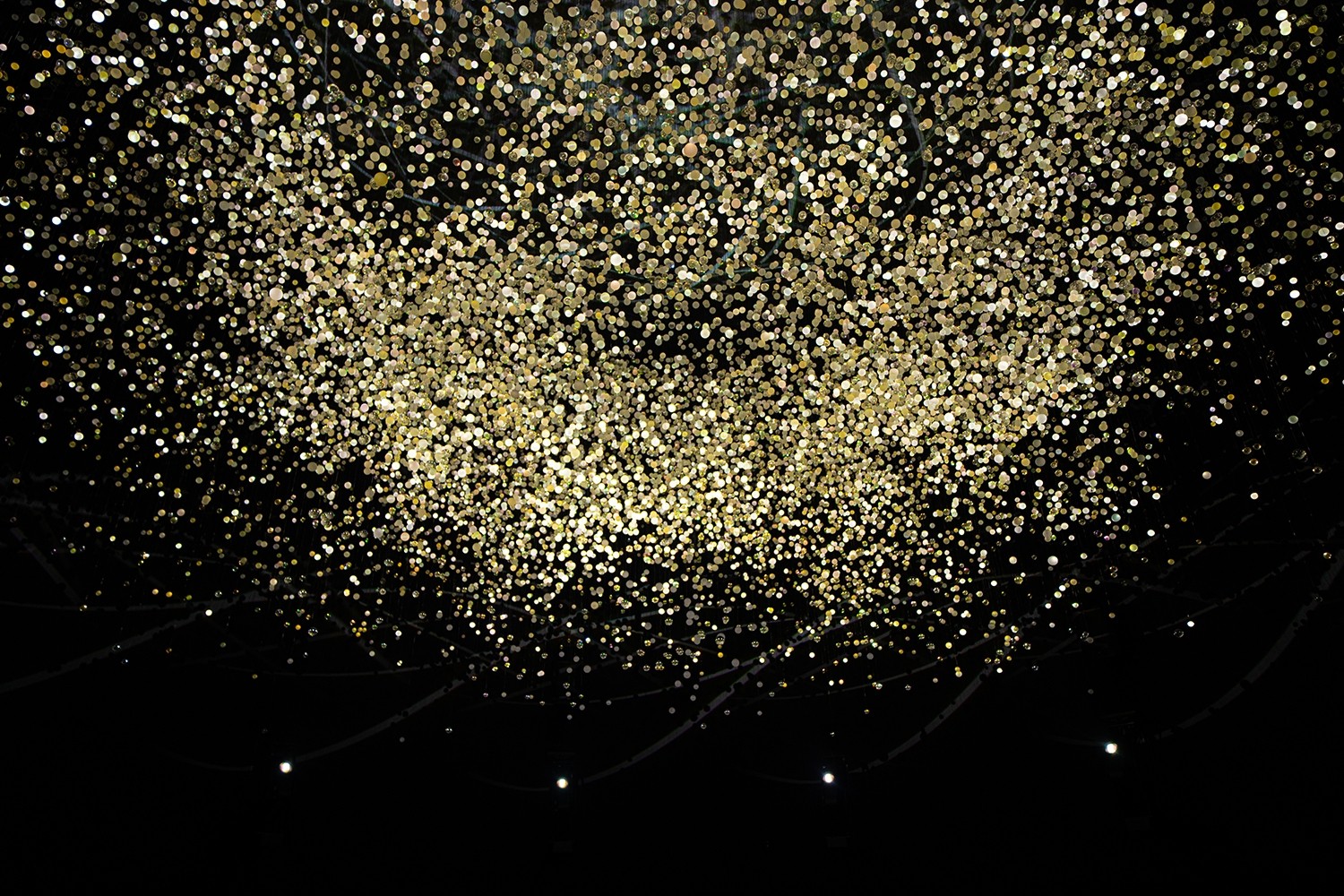
Photo credit: LUCENT

Photo credit: LUCENT
Recognition came quickly: Student CG Contest Grand Prix and SFC Digital Art Award Grand Prix in 2003, a Creative Human Award in 2004, an Asia Digital Art Award in 2006 and the Laval Virtual Award for Phantasm in 2008. After graduation, Matsuo worked in a CG design office and founded Monoscape in 2007. From the late 2000s, his work gained wider international visibility through Ars Electronica, as well as participation in FILE in Brazil, SIGGRAPH in the United States and Canon’s NEOREAL exhibition at the Milan Salone in 2009.
Around 2011 and 2012, his practice moved toward light as the central medium, with White Rain being widely considered as his first lighting installation. In June 2012, Matsuo founded Lucent Design, establishing it as a studio for light artworks, spatial design and technical development. From there, his work expanded into large installations, permanent artworks and collaborations with brands and institutions including BVLGARI, SEIKO, Shiseido, Cassina IXC., KAWAI, La Mer, PIAGET, MIKIMOTO, Conrad Osaka, Mandarin Oriental Shenzhen, Haneda Airport and Expo 2025 Osaka, Kansai. In 2020, the designer launched EMISSION, extending his practice into prism artworks and objects, with his more recent success being The Creation, which won Entertainment Lighting Design of the Year at the LIT Lighting Design Awards 2024.
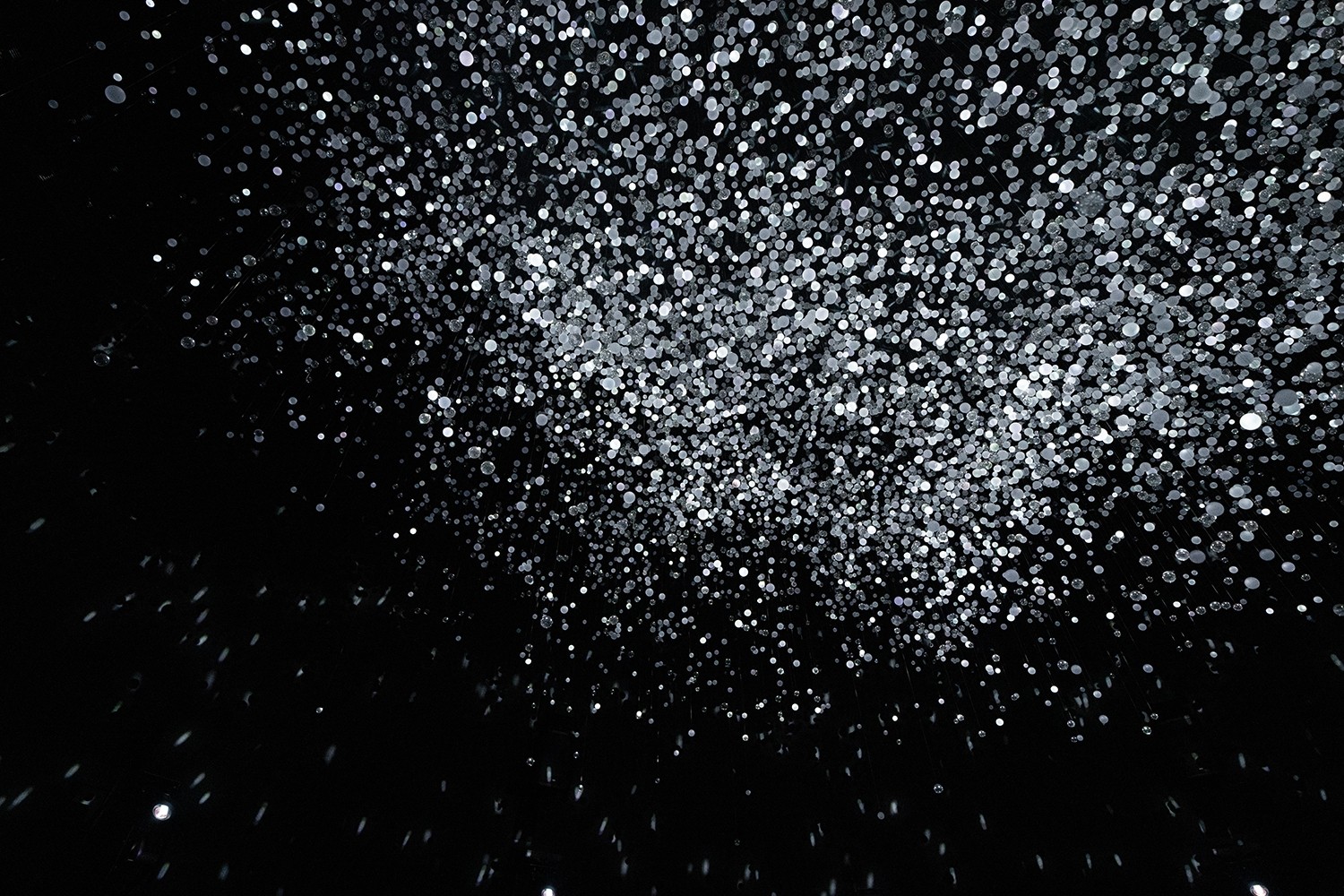
Photo credit: LUCENT
How does Matsuo create his one-of-a-kind light art?
“The expression of light is beyond comprehension. It’s fascinating, that’s why there are so many possibilities. I take each approach and create art. Delivering that to people is what light is all about. We work out the shapes using paper, then make a 3D computer model. We decide on the number of layers and elements and create a sense of randomness.”
Takahiro Matsuo (NHK World)
Matsuo always begins with form. He works out shapes himself, often through paper studies, passing them afterwards into 3D computer models. From there, he sets the structure of the piece in detail, deciding the number of layers, the number of elements and the degree of randomness of the final composition. His method is, therefore, a hybrid one. Sketching, spatial modelling, programming, system design and tuning on site are all part of the same process, with the work moving back and forth between analogue and digital.
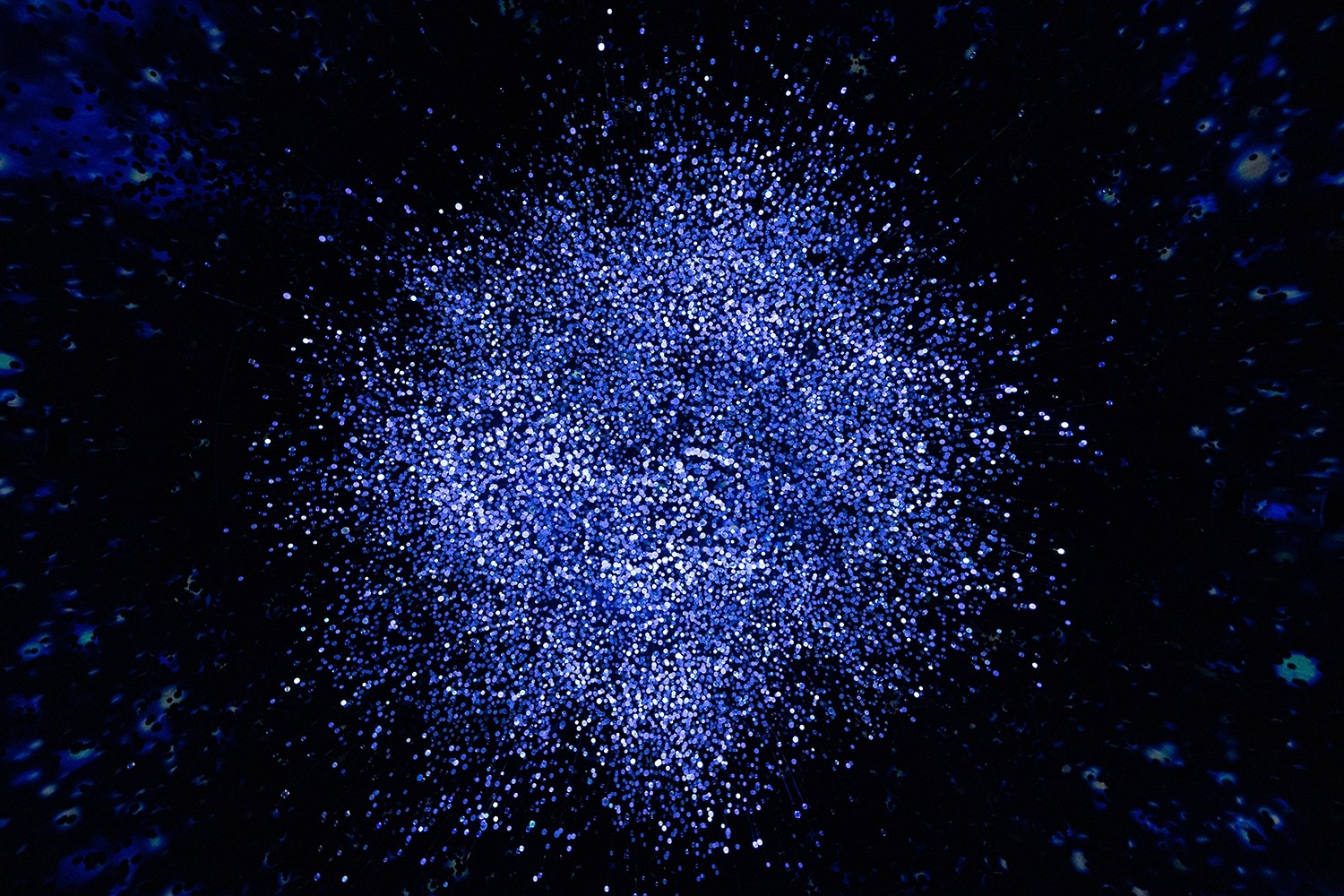
Photo credit: LUCENT
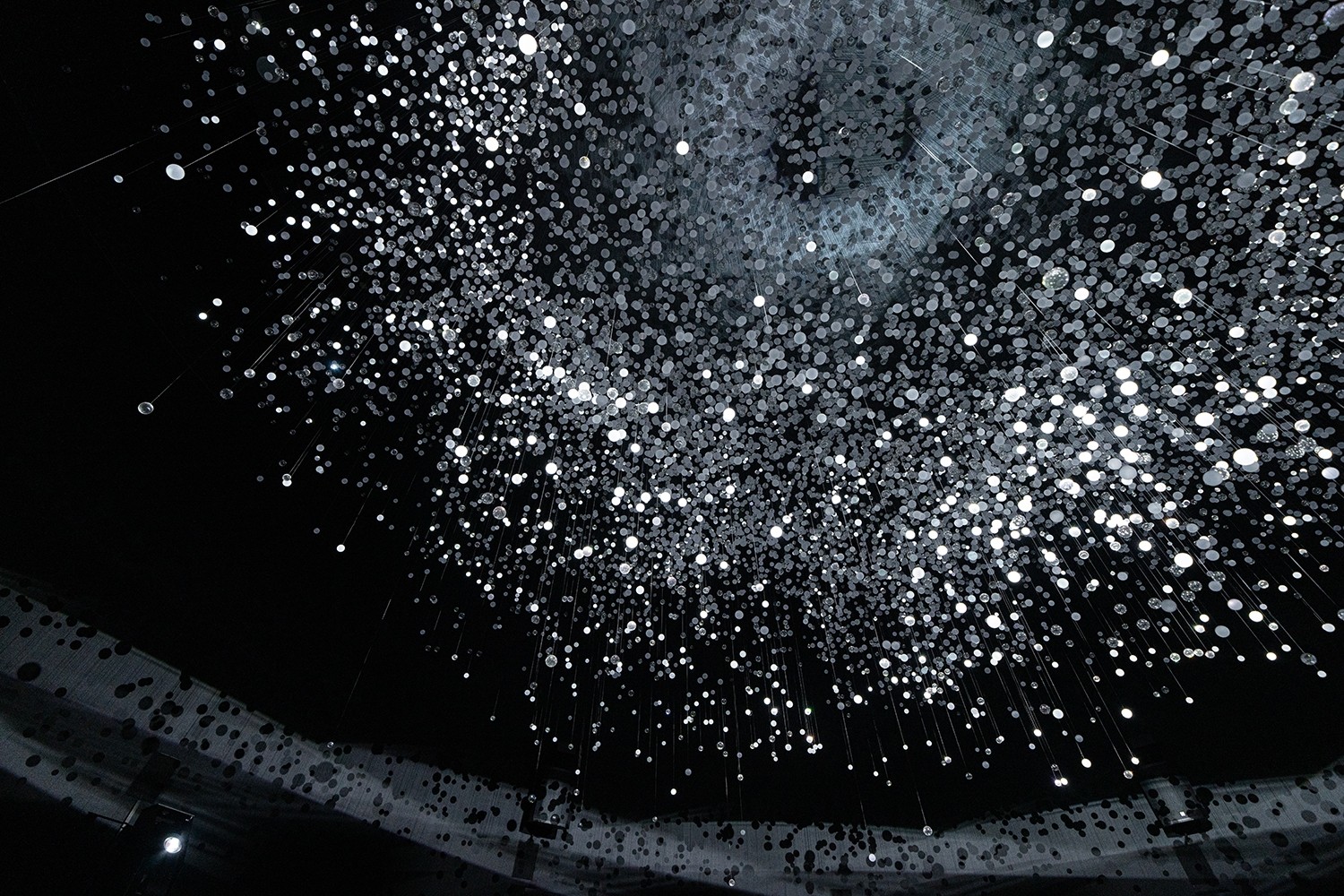
Photo credit: LUCENT
Matsuo builds light art as an environment construction of sorts, combining video, lighting, music, technology, objects and interaction together as one huge spatial work, often based on natural phenomena or laws. The viewer’s body is usually part of the piece, with presence, movement and proximity changing the light, the density of the image or the atmosphere of the installation. Control algorithms are used to avoid continuous repetition and to keep the work in motion. In Aquatic Colors, for example, the designer used real-time CG and an algorithm based on 1/f fluctuation found in nature, while White Rain used software-controlled gravity and a random physics algorithm to create rain-like movement in real time.
White Rain: Matsuo’s first installation based on light
“I had this thought that I wanted to create a space using only white light of varying intensity. I guess I realised that the things I’ve found beautiful all have something to do with light. For example, reflections or something being see-through. Also, landscapes, as well as the sky, the stars and everything. Not artificial light, but the light created by the sun. That was something that I found resonated with my aesthetic sensibilities.”
Takahiro Matsuo (NHK World)
White Rain marks Matsuo’s move from projection-based interaction towards an installation built from light itself. Rather than relying on screen imagery, the work uses the movement and intensity of white light to suggest falling rain and to produce an extended, almost boundless sense of space. Its structure is made from suspended LED elements and acrylic bars, with light passing through transparent material and reflecting back so that visitors see a field of luminous droplets.
The piece was created with the help of technology, with Matsuo having used software-controlled gravity, an LED device and a random physics algorithm to create a constant rain of light in real time. The installation also responds to the viewer, with the intensity of the light rain increasing as a person approaches. White Rain was first introduced in 2011, at the POLA Museum Annex in Tokyo, having later been exhibited at Matsuo’s 2012 solo exhibition at ARTIUM in Fukuoka.
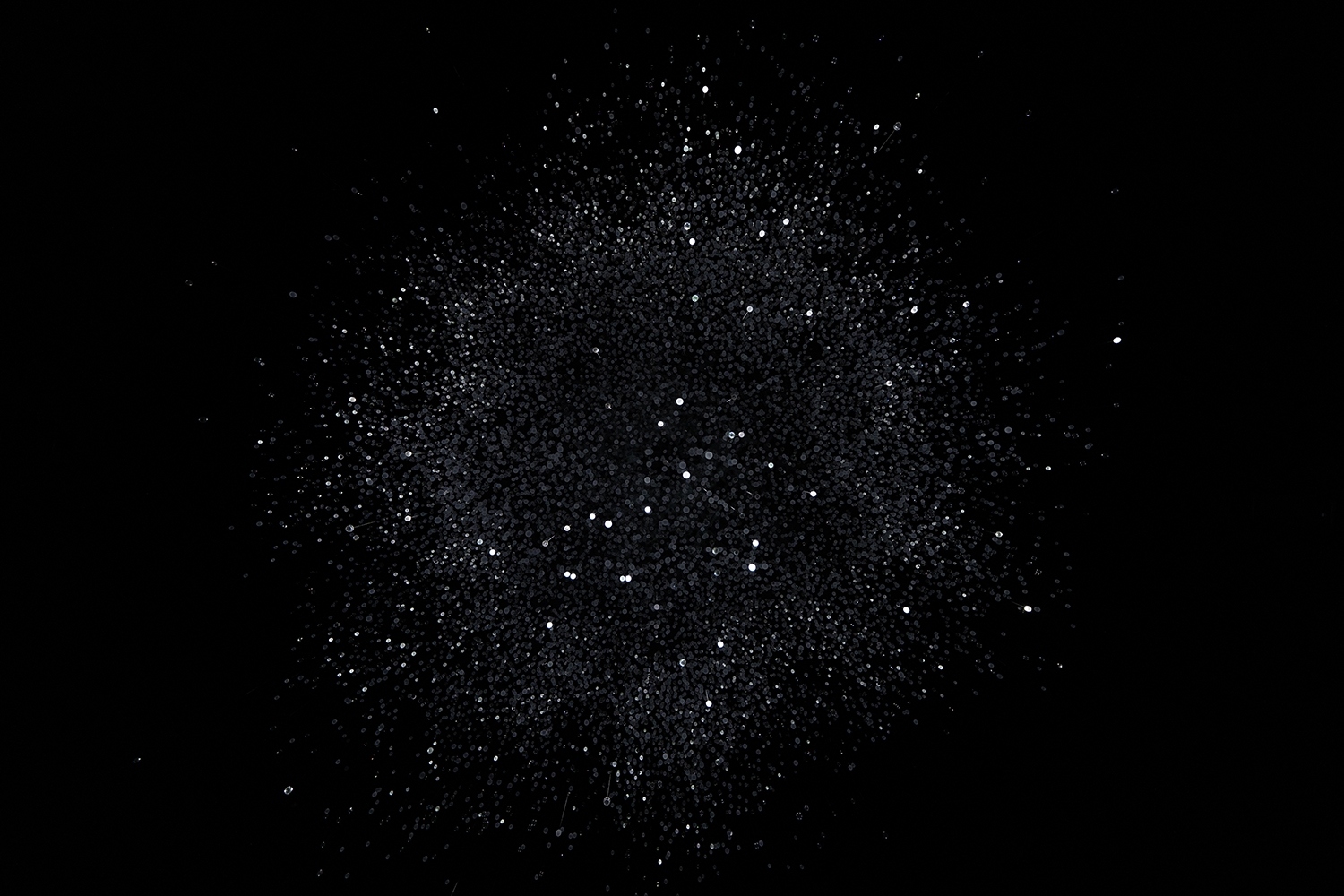
Photo credit: LUCENT
AURA: Matsuo uses natural light
“[During the night, Aura] is illuminated from above to create a really gorgeous evening look. During the day, sometimes you get direct sunlight, other times it is soft and gentle. That makes the piece look like a clear, vibrant sky.”
Takahiro Matsuo (NHK World)
In the AURA series, Matsuo worked with prisms developed in-house that work alongside natural light to create the desired effect. AURA/CONRAD OSAKA was exhibited in 2017, having been made from 30,000 small elements arranged as a cloud. The effect of light in these prisms changes throughout the day as sunlight moves through them and eventually shifts to the calm glow of the moon. Its translucent, prismatic body catches and redirects light so that rainbow effects appear, spreading them into the surrounding area.
A later version, AURA/Mandarin Oriental Shenzhen from 2022, was designed following the same method, this time as a permanent installation made from around 3,400 elements arranged as a pillar of light. It was inspired by the growth of salt crystal bodies, and its luminosity changes with the viewer’s angle of view. “It looks transparent but is actually not,” said the lighting designer, adding that “light enters and exits at a different angle.” Across the AURA works, light plays with prism elements so that sunlight, perspective and surrounding illumination keep remaking the piece.
Kinetic Light Vision: illuminating floating spheres
Kinetic Light Vision is Matsuo’s original spatial art system developed by LUCENT for the Shiga booth at the Kansai Pavilion of Expo 2025 Osaka, Kansai. In that first version, the installation used 450 glowing spheres suspended in mid-air and combined them with projected images of Shiga’s beautiful landscapes. Matsuo conceived it as a system where physical movement and digital imagery act as one sequence.
“The spheres don’t emit light, they merely reflect light from a spotlight to make it appear like they’re luminous. So there aren’t obstructions, we light them up from underneath. (…) When I work on a project, I’m always trying to change the assumption that spaces should be static. (…) That creates a sense of time… a timeline. So, at the Expo, I wanted to move the light itself as much as possible.”
Takahiro Matsuo (NHK World)
The system was engineered from scratch by LUCENT, with motor control, prototypes for ultra-narrow spotlights and repeated testing having been made to ensure the exhibition could operate reliably over a long period of time. K.L.V. later continued beyond the Expo and became a reusable light-motion system. At Omotesando Hills Christmas 2025, for example, it appeared as a circular installation in which 48 spheres were synchronised with music to represent rings of light around a prism tree.
Trails World: interactive pieces
“Interactive art is based on human participation, and I just found that really intriguing. For my second piece [Floating Light], I created an experience where you wear a device on your hand that lets you activate light. I became interested in exploring the relationship between people and art in my work.”
Takahiro Matsuo (NHK World)
Trails World is one of Matsuo’s earliest interactive works, dating from 2002. In the piece, the participant uses a pen and uses it to draw on an interactive screen. It is the movement of that pen that generates luminous geometric forms that resemble crystals or flowers, accompanied by music. The image does not stay fixed after the gesture is made, instead giving way to new ones. Colour and form continue to change through an organic algorithm, so the exhibition works as a live exchange between the participant’s movement and the system’s response. The work was also entered as a research project in the same year, when it was published in the Journal of the Society for Art and Science.
The Creation: Astrid Hébert’s thoughts
“The first impression of Takahiro Matsuo’s work “The Creation” was a sense of space and a sense of light… like we’ve been transported into another universe.”
Astrid Hébert, Co-Founder and Programme Director of the LIT Lighting Design Awards
The Creation is a light installation completed in 2023 at the Ui ART Center in Suzhou, China. In 2024, it received the top prize at the LIT Awards, having been crowned “Entertainment Lighting Design of the Year”. The work is a spatial installation that uses spheres, projection and sound to create awe. It is organised in three scenes, Birth, Shine and Vortex, treating the cosmos as its main subject. Through light and design, Matsuo explored the origins of the universe and nature, while also tracing how human activity shapes built environments such as cities.
You can learn more about this installation in the video The Magician of Light: Matsuo Takahiro, where Matsuo explains the project in detail.
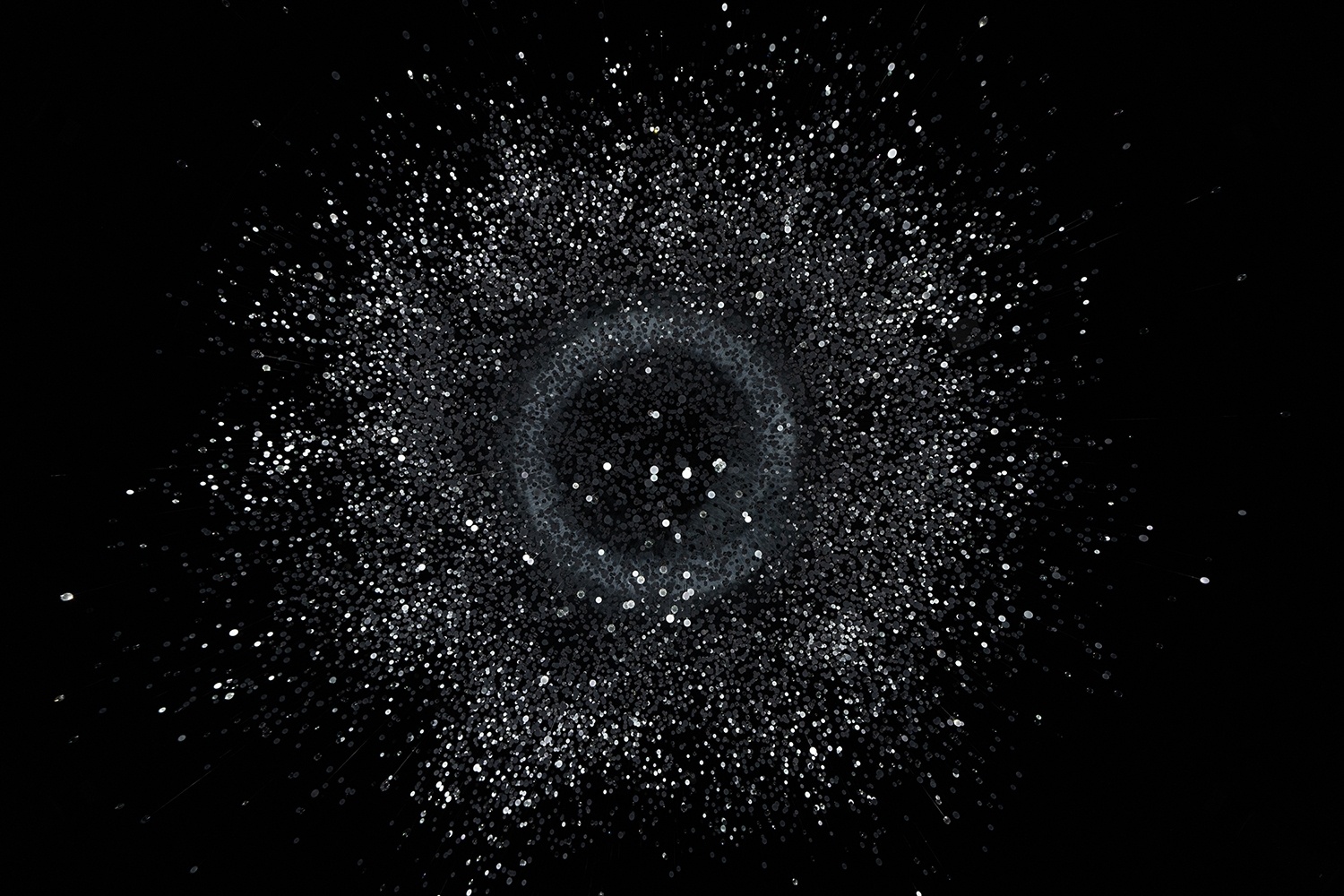
Photo credit: LUCENT
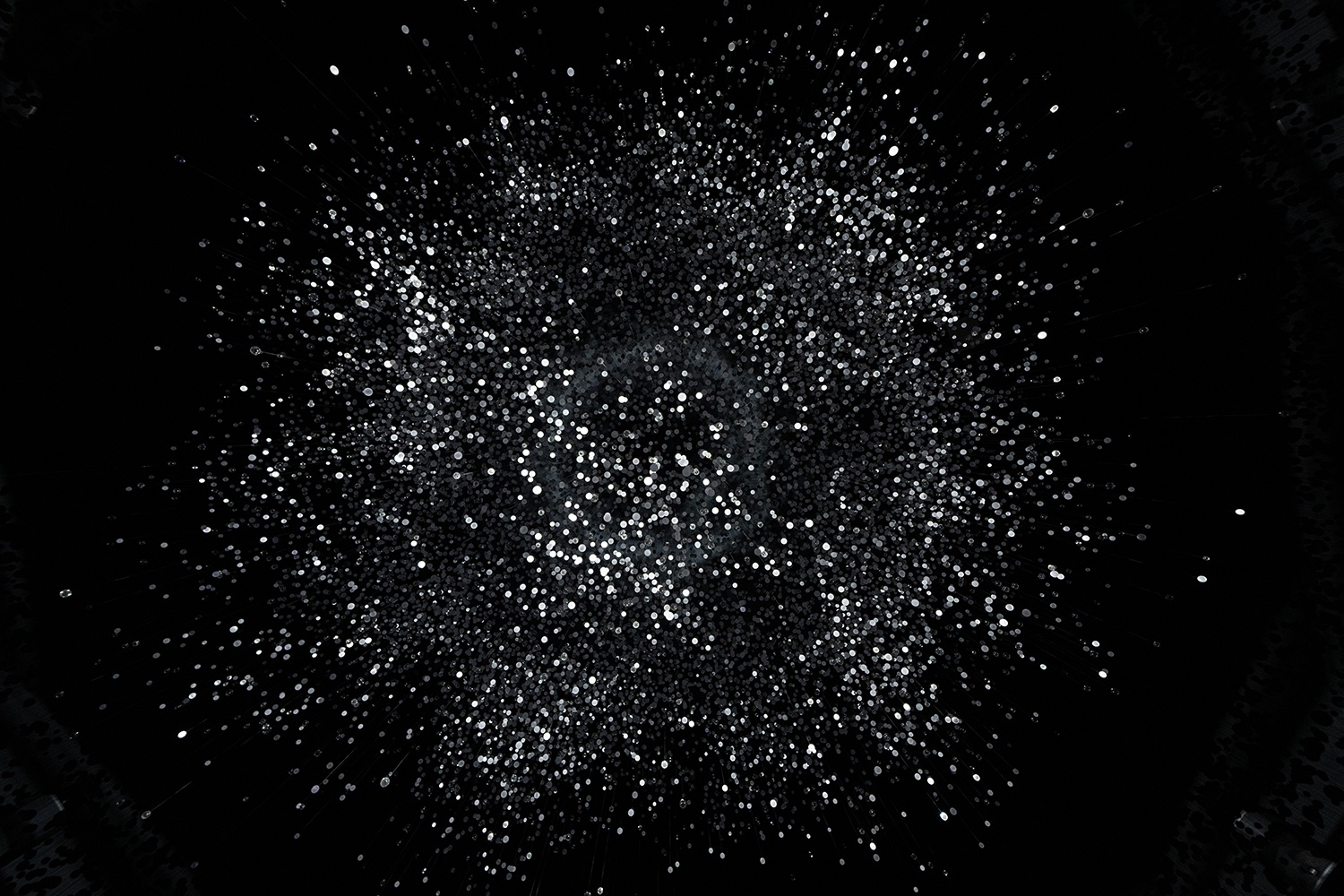
Photo credit: LUCENT
The design began with digital computer graphics and physical simulations, which Matsuo used to generate a galaxy-like agglomerate of dots. That digital model was then given a physical form, having been made from 20,335 transparent and translucent acrylic spheres in different sizes, each placed at exact 3D coordinates. The spheres are suspended on ultra-thin wires, so the whole structure looks as if they are floating in space.
Light is added through 12 projection units, which create shifting clusters that flicker, merge and change across the space. The transparent spheres reflect this light, while the translucent ones absorb it and glow. By projecting from several directions, Matsuo was able to produce changes in texture, colour and flicker.
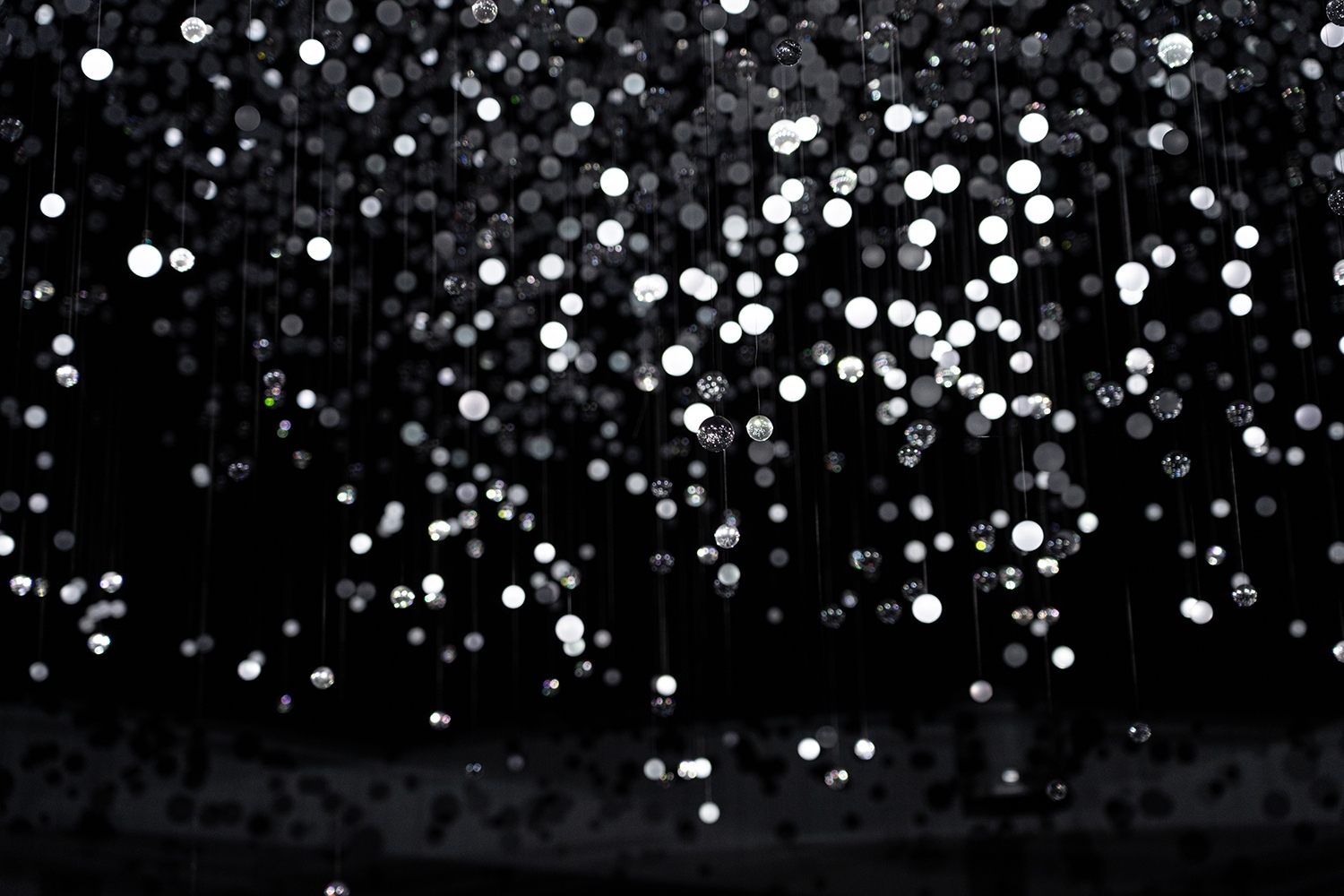
Photo credit: LUCENT
“Japan is Japan… overseas is overseas.”
“When I started making light art, I didn’t go into it with a clear vision of the kind of work I wanted to create. Rather, through the process of creating, I updated my awareness, which led me to think about the next thing and then the next thing,” said Takahiro Matsuo in an interview with NHK World. The designer continued: “I have no interest in taking a piece we unveiled in Japan overseas. Japan is Japan… overseas is overseas. I want to create something unique to a location by embracing what they have to offer. That’s the way I want to expand my practice.”
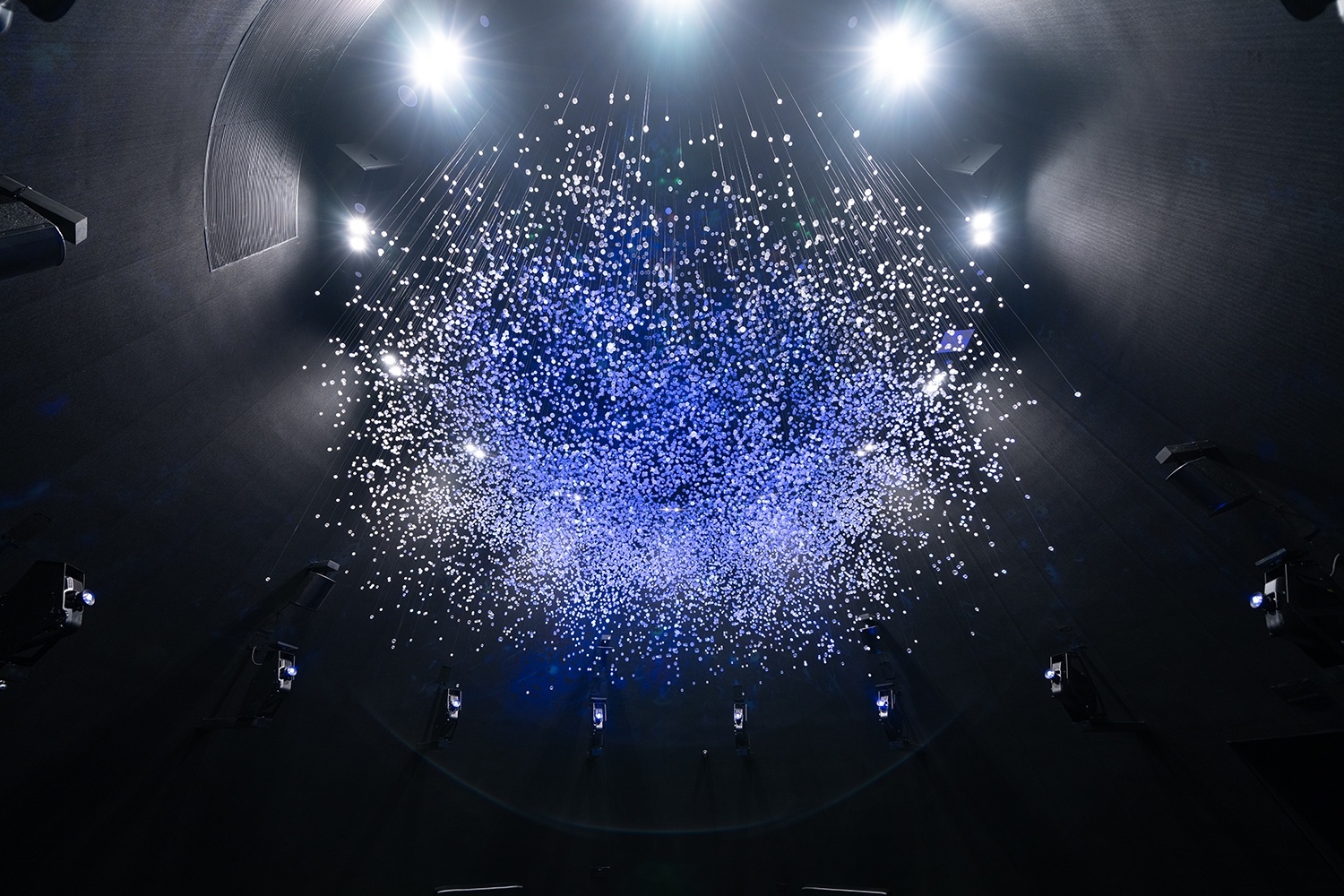
Photo credit: LUCENT
When asked if he has any words to live by, Matsuo is quick to add that his motto is “Light is an endless pursuit”. As an explanation, which encapsulates not only his work vision but also his own life philosophy, the designer said: “I create all sorts of light in my work and have found it is truly unknowable. The sky and the stars seem so close but are out of reach. Things like that I can’t recreate. At the same time, by using human technology, I can create things such as lighting and video equipment, devices that can essentially substitute for light.”
“I believe I can expand on that and create new opportunities. There’s no end goal there… just endless possibilities. Conceiving of the tools is a quest in itself, which, in turn, feeds into my own artwork, my own projects.”
Takahiro Matsuo (NHK World)


