



Header: Virgile Simon Bertrand
With the end of 2025 in sight, one might feel tempted to start dreaming about what 2026 might bring. New colour trends, perhaps? A full-on Brutalism revival? Surely, Bauhaus should be explored more? And while these thoughts are fun, this author thinks we should first look at the styles and trends that defined the last 12 months.
So, which projects scream “This was 2025”? While there was a lot to choose from, some movements stood out: futuristic forms, sustainable architecture, and a return to the roots. The industry kept itself busy, and while there isn’t a single major trend, it doesn’t mean things feel too stretched. On the contrary, it seems like innovation and creativity are what defined the year, making the wait for what’s to come even more exciting.
Hotels that don’t overthrow nature
On the rocky edge of Huanglong Island in China’s Zhoushan Archipelago, the Huanglong Island Lighthouse Hotel was designed by WJ STUDIO to fit right in with its surroundings. The objective was never to stand out, so the hotel keeps a low profile and focuses on the basics: a setting defined by wind, sea, and exposed rock that can be framed for views and adored by guests from all over the world. Sustainable hospitality has been one of the main themes that reigned over the architecture industry throughout 2025, so this project just had to make the list.
The hotel is divided into several buildings, each of them overlooking the reefs in spots chosen by the land itself (as the designers followed its contours and avoided any restructuring). The rock formations were left as they were and, in some places, adapted into the architecture. This is seen most clearly in a central rock hall where a huge reef sits beneath skylights. Guests are guided from one viewpoint to the next by following developed paths carved by the contours of the rock. Inside the rooms, windows are placed to frame the sea, the rocks, and the horizon, so the landscape does most of the talking.
Modern looks and historical inspirations
Surrounded by vineyards just outside San Miguel de Allende, Casa San Francisco is a holiday home designed by Jorge Garibay Arquitectos that represents a study of how local architecture has evolved. Instead of using the usual regional style, the architects attempted to trace how architecture arrived there centuries ago and adjusted over time, having been inspired by convent buildings, winemaking, and the dry landscape. It made the list for a simple reason: it’s one of many projects that focus on getting the right traditional materials for a rural, agricultural setting while having a clean modernist form. Rural modernism, if we have to call it something.
The layout is made up of five separate volumes rather than a single structure, which lets each wing open towards the vineyards and wider views. A long corridor connects the buildings and divides the public spaces to the west and the bedrooms to the east. The material palette is intentionally tight, as the architects decided to rely on locally sourced stone, unpolished Mexican marble floors, and hand-applied lime plaster, all chosen to weather slowly. Light does a lot of the work here too, as the interiors were designed to reflect the same warmth and softness found in older convents, which used daylight to reach an almost ethereal atmosphere.
Futuristic confidence
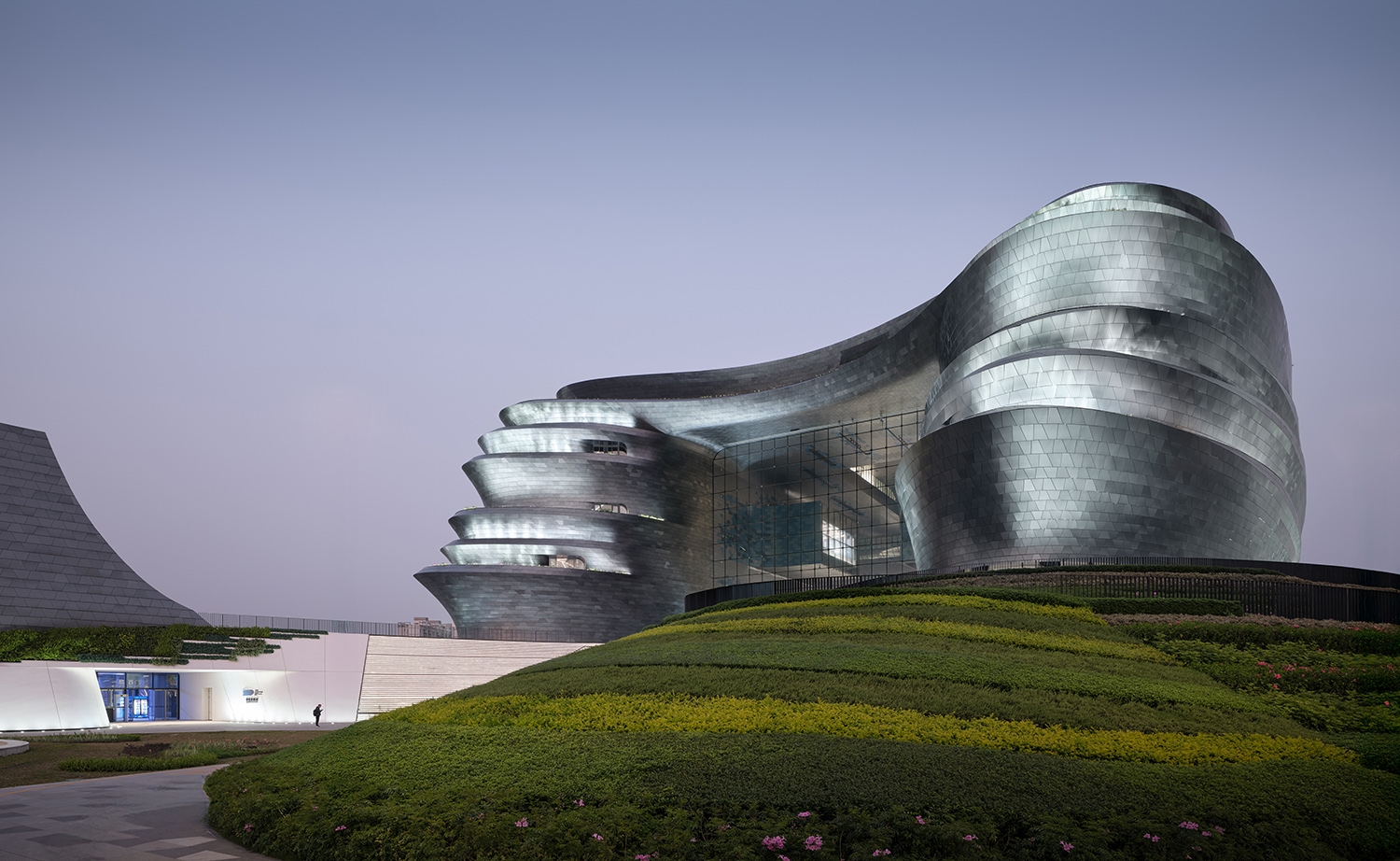
Zaha Hadid Architects’ new Science & Technology Museum made the list for a very obvious reason: its form. The curve, the scale, and the overall confidence are part of a wider pattern we kept seeing this year, where architects lean into bolder shapes to reflect ambition and innovation. This project captures that movement quite well, as its exterior feels deliberately futuristic and expressive.
The building has a rounded stainless-steel shape that looks the city right in the eye and then gradually opens as it stretches towards the park through layers of terraces that function as outdoor galleries. Inside, everything revolves around a large central atrium designed as the main public room, which brings in daylight and guides visitors up towards the galleries. The exhibition spaces actually seem to follow the same logic as the façade, appearing to grow out of the floors and walls rather than being common, closed-off rooms. The intent is clear: come, enter, we are sure you will like what is inside.
Architecture that feels grounded
Casa Plaj, designed by Extrastudio, can be found on a narrow, steep plot above the sea near Lourinhã, in the Portuguese countryside. The clients found the land almost by accident and were drawn to its openness, the closeness of the beach, and the quiet backdrop of orchards and small village houses nearby. Instead of asking for a big architectural work of art, they requested something light that would allow them to live closely with the land. It is present on this list because it represents many of the houses that passed through any design writer’s desk this year: residences that try to do less and let the landscape stay in charge, with architecture taking its place as part of the whole rather than the main event.
Built into the incline, the house keeps space compact, only extending it with several terraces that catch different views of the sea and the valley. Inside, the plan is simple and efficient, with living spaces opening to the wild and bedrooms facing south to make the most of light and climate. Materials are also simple, from bare plaster walls to stone surfaces, windows that slide away, outdoor areas welcoming of daily routines, and a slim pool slightly hidden among pine trees that runs. The land around was mostly left as it was, with fruit trees having been added so the family can end up living with the landscape rather than just looking at it.
A modern take on tradition
The Liwa Farm Village is located inside a working plantation in the Liwa Oasis, right on the edge of Abu Dhabi’s Rub’ al Khali desert, and was designed by architect Inca Hernandez and his team. Exotic for the rest of the world, these structures were designed to support farming, hosting, and everyday life while adhering to the traditional elements and styles of the region. This project represents all projects that looked at traditional building habits that have already proven their worth in intense environments, which, in this case, are the heat and sun, and decided that there was no need to look any further.
The walls are thick rammed earth made from local sand mixed with concrete, a mixture that helps buildings handle the climate in a way lightweight structures never really can. Everything was laid on top of pigmented, washed concrete platforms that help deal with the desert soil, while clay lattice screens cut the sun glare and let air through. Roof forms follow the logic of windcatchers, drawing hot air up and out to improve natural ventilation. The buildings house an arrival space with water, a majlis for gathering, a restaurant that serves what’s grown on the land, a spa around a courtyard, and spaces for exhibitions, date processing, and farm support, plus a few quiet bungalows for family and guests.
Whether you prefer sharp lines or organic flows, seas of trees or jungles of cement, there was a lot to be inspired by in 2025. Modern shapes seem to have been the favourite, with designers from all over the world trying to give the movement their own touch. This made for an impressive array of projects and ways of living and keeps us on our toes for 2026. With this in mind, the only thing left to ask is: what are you hoping to see in 2026?


