

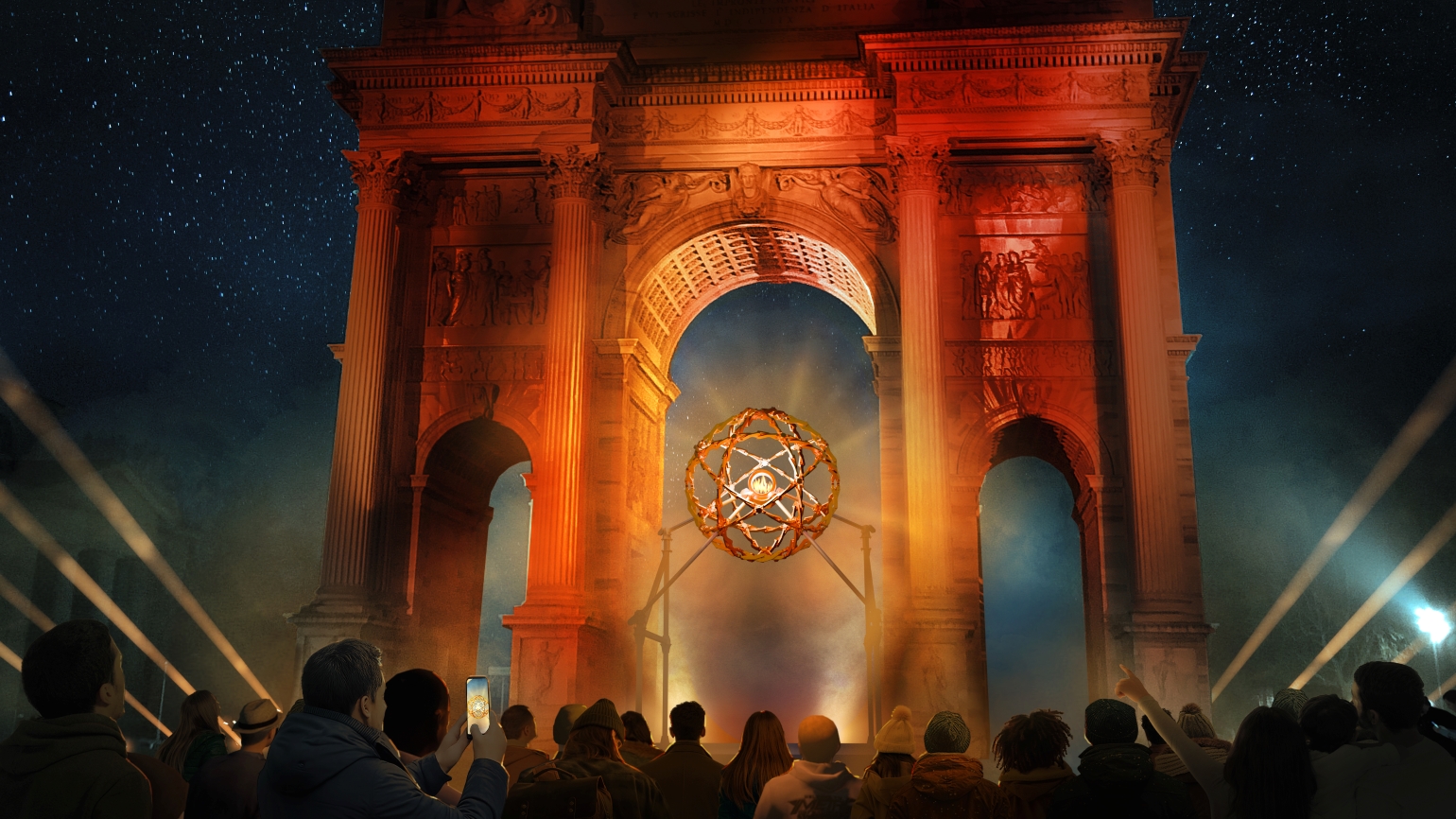
Widely regarded as one of the most meaningful symbols of the Winter Olympics, the cauldrons were designed by Marco Balich, Creative Director and Olympic Ceremonies Producer. For the first time, the cauldrons will be lit in two cities, Milan and Cortina d’Ampezzo, in perfectly synchronised ceremonies. This synchrony symbolises the power of the Olympic and Paralympic Games to unite cities and people. Both cauldrons will remain in their respective cities until the end of the Olympic and Paralympic Winter Games. They will be extinguished the same way they were lit: simultaneously in both locations.
Leonardo da Vinci-inspired design by Marco Balich
The two cauldrons stand as striking symbols of harmony between the people and territories participating in the games. The exact locations of the cauldrons include Arco della Pace in Milan and Piazza Dibona in Cortina d’Ampezzo. Cauldrons are inspired by the sun as the source of energy, life and renewal. The flame, historically considered the symbol of continuity and rebirth, becomes the heart of creation.
The design culls from the famous Renaissance artist Leonardo da Vinci’s knots – geometric interlacing patterns which embody the balance between human ingenuity and nature. Leonardo’s selection was far from coincidental, as the artist lived in Milan between 1482 and 1499 while painting his masterpieces, The Last Supper and The Virgin of the Rocks, for the Confraternity of the Immaculate Conception at the monastery of Santa Maria delle Grazie. The city is also the home of the Leonardo da Vinci Museum of Science and Technology.
Light, Time, Material
The cauldrons are dynamic structures that can open and close. Crafted from durable yet lightweight aeronautical aluminium, the cauldrons embody the continuity of time and the natural rhythm of day and night. While expanding and contracting, these cauldrons subsequently protect and expose the Olympic Flame. When closed, the diameter of the structure is 3.1 meters, but expands to 4.5 meters once open. Exactly 244 pivot points and 1,440 components (mounted on pins and bearings) make up the backbone of the complex mechanical systems. The flame is kept in a container made of glass and metal, which allows for minimal smoke emissions, environmental safety, low acoustic impact and stops material from falling out.
The cauldrons will remain lit throughout the Olympic and Paralympic Games
Cauldrons will be lit at a ceremony held on February 6th, which will mark the end of the Olympic Flame Journey. The journey covered over 12,000 kilometres across 60 cities and 110 provinces throughout Italy. 63 days later, the flame will finally arrive at the opening ceremony, marking one of the event’s most emotional moments – celebrating unity and the energy of the games.
The next day, the cauldron at the Arco della Pace in Milano will host a remarkable daily event, which will take place between 5 pm and 11 pm and will last 3 to 5 minutes per day. The event will be open to the public and will be repeated every day until the flame is put out. The fire will be doused on February 22, 2026, only to be relit at the beginning of the Paralympic Games on March 6. The flame will be extinguished on March 15, this time permanently, at the grand Paralympic Closing Ceremony.