

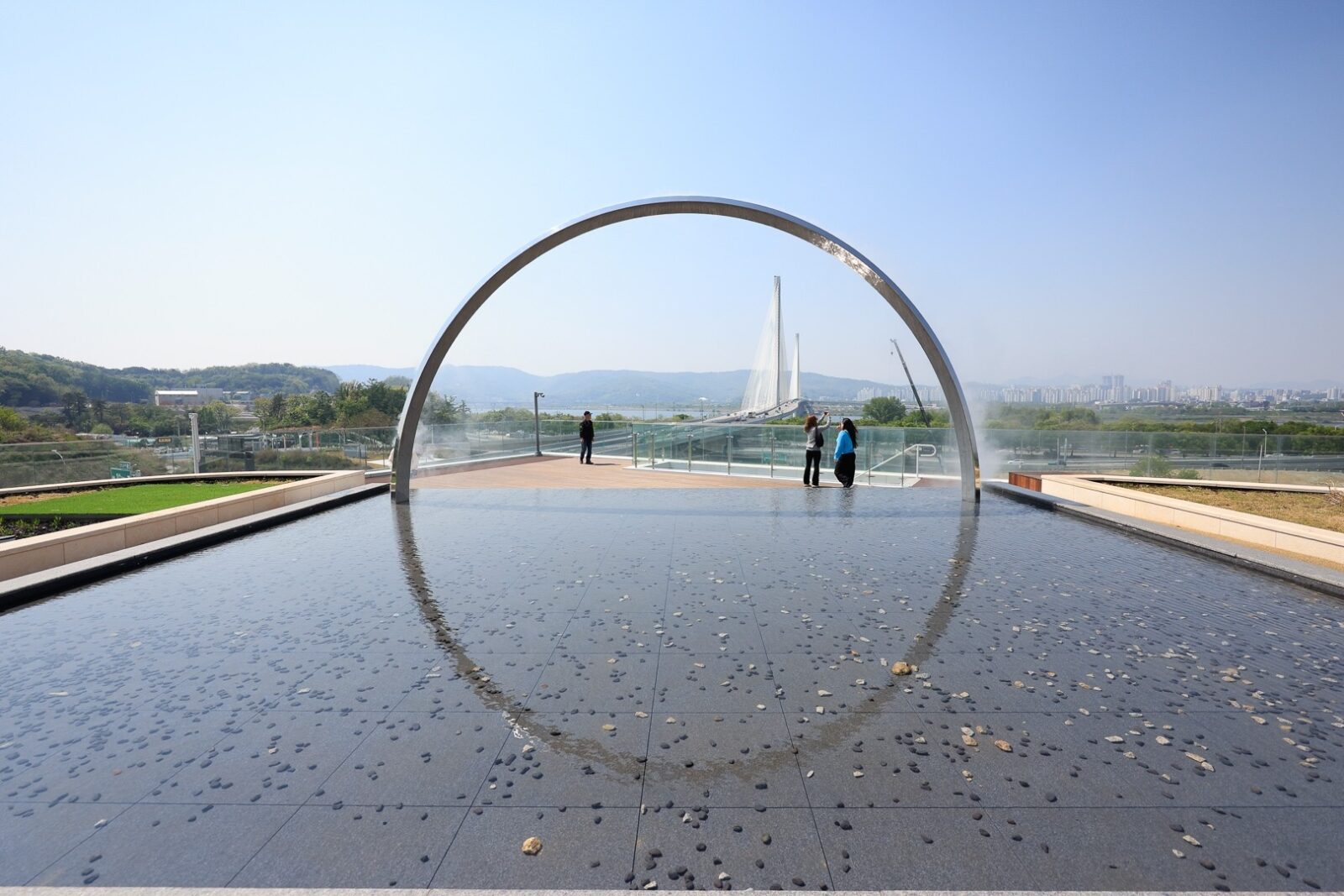
Lighting installation Arc ZERO: Eclipse is not an object so much as an encounter. Rising from a reflecting pool on a rooftop overlooking the Han River in Seoul, the installation uses light, mist, and atmosphere to momentarily dissolve the familiar rules of space, scale, and perception. Created by Australian artist James Tapscott of Studio JT, the work transforms elemental materials into a circular apparition that feels at once precise and elusive, engineered yet deeply poetic.
Winner of the Entertainment Lighting Design of the Year title at the LIT Lighting Design Awards, Arc ZERO: Eclipse, builds on Tapscott’s long-standing exploration of light as a spatial and sensory medium. Neither purely architectural nor purely sculptural, the piece exists in dialogue with its site, the skyline, and the shifting conditions of wind, humidity, and time. In this interview, Tapscott reflects on his journey from painting to large-scale light works, the evolution of the Arc ZERO series, and how restraint, sustainability, and a deep respect for natural phenomena continue to shape his practice.
Could you tell us a little about your background and how Studio JT came to be?
I originally studied painting at art school and figured that would be my career until travelling to the US some years afterwards – I was amazed at the works I saw in California; Richard Serra, James Turrell, Olafur Eliasson, Robert Irwin, etc. My education was pretty limited prior to the internet due to Perth’s geographical isolation and so these works were a real eye-opener as to what else art could be. So I transitioned, slowly (it’s hard to turn your back on 10+ years of practicing a medium) and grew my style of working in the more remote areas of Australia, playing with light and the landscape. Eventually, this led to commissions for large-scale works, both temporary and permanent, and Studio JT was formed to embrace this growth.
What was the original vision behind the Arc ZERO series, and how did that idea evolve into Arc ZERO: Eclipse?
The first Arc ZERO was commissioned by Art Front Gallery in Japan for the inaugural Japan Alps Festival. It was really a direct response to the site and curatorial theme of water. The site was a small forest at the entrance to an important temple called Hotokizaki Kanon-Ji with a strangely angled bridge over a rushing stream. This exact site just felt important in a way, and also served as a crossing, not just of the river, but from one place to the next. The work’s intention was to frame this crossing and mark the moment one moves through to a more spiritual realm. The nature of the site was so beautiful, I wanted to be equally as elemental in my choice of materials and form, so a circle of mist and light was the best response.
The next iteration of the work was in a vastly different environment – a new shopping mall in Shenzhen. It still had a few shop spaces unleased and so the curator, Keith Lam, produced a fantastic exhibition of works by artists around the world to use these spaces. It was a more controlled space, and much more minimal, so I sought to create a work that was more visually profound. Using the water pooling from the condensed mist to create the full circle with its reflection did something amazing to one’s perception of the space – as if there was no floor, no horizon, even no gravity since all other visual reference points were eliminated in the dark space. The artwork cast a shadow within itself, too – in space (rather than on a surface where we normally encounter shadows). It was a hugely successful piece, attracting over 400,000 people who lined up to see it over the course of a month.

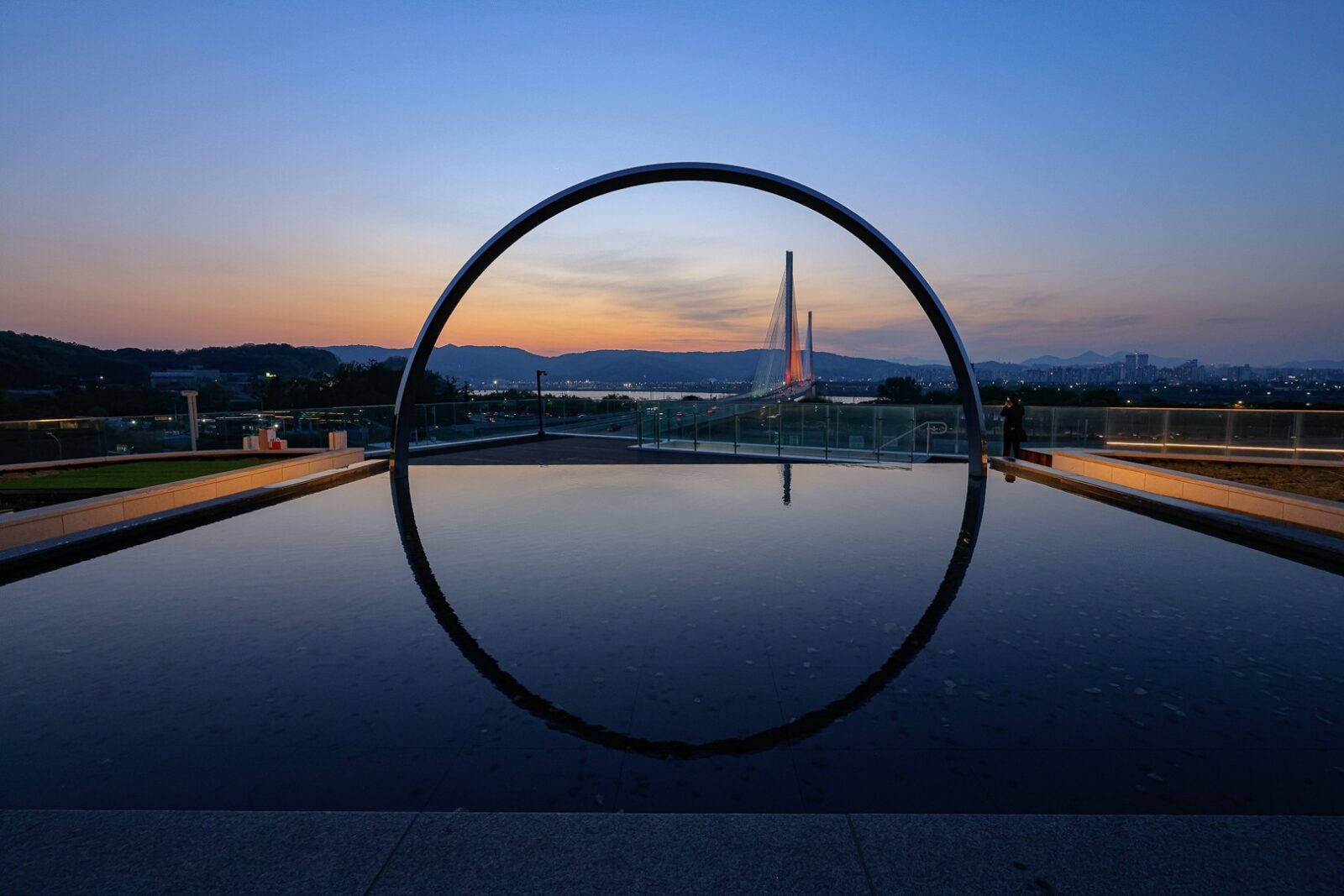
Why did you choose this precise combination of a rising arc and reflecting pool, creating a complete circle in perspective, and what kind of visual experience were you aiming for for viewers looking over it from the roof?
I think it creates an experience of greater immersion in the site itself, not just the work. The normal visual rules we use to assess and navigate space don’t really apply, so one tends to become more observant and open to the raw visual information they’re receiving. The work itself needs the site to be complete, which brings together a sense of harmony and interconnectedness. My work is all about producing a moment of pure co-existence with nature, so it functions on many levels in this way. The circle is such a pure form, it doesn’t bring any intellectual baggage that can cloud this experience, and also fits perfectly with the overall curation of the development’s art collection, based around the Cheonbu concept.
Light, mist and atmosphere are the real “materials” of this piece. How did you approach the lighting design so that the mist, the ring, and the surrounding skyline all interact in the way you imagined?
The strategy (as it is with much of my work) is to allow all the elements to speak for themselves. The unique texture and organic movement of the mist are so special that they just need basic illumination. And because the mist is what gives form to the light, this symbiotic relationship is crucial to the success of the work and what makes it unique. I think this approach also allows the work to really shine in any environment, as most urban lighting has a completely different aesthetic quality. The presence of something purely natural becomes much stronger, but doesn’t dominate or detract from the intention of the surroundings’ design strategy.
When the mist ignites with light, it can look like fire, shadow, or even an eclipse. What kind of emotional response from visitors were you hoping to create through this play of light and vapour?
I’m hoping people can achieve a true sense of wonder with my work – something sublime, which is what I think facilitates a moment of pure coexistence. They can stop processing everything they experience cerebrally, with language (which can be very limiting) and just feel their moment with the site. It’s also one of the reasons I work with mist in this instance, as it engages all the senses. It’s not just a visual, or even audio-visual experience, but a bodily one, with smell, touch and even taste contributing.
You have mentioned that the ring has a diamond profile. For readers who haven’t seen it in person, can you explain what this profile does visually, and why minimising self-reflection was so important to you?
It prevents any chance of a reflection of oneself from most of the viewing angles. I find that seeing myself in the surface of an object completely overrides whatever else I’m experiencing, and really breaks the moment. So I want people to be able to lose themselves in the work. It certainly makes it a lot more complicated and expensive to fabricate, however, so this approach is reserved for the permanent editions.
Arc ZERO: Eclipse builds on your earlier Nimbus works. In your view, what are the key differences between this installation and Nimbus, and what do those changes say about how your practice has evolved?
While still being visually striking, Nimbus becomes much more of a bodily experience as it is more immersive; one walks through the ring as they cross over the bridge it encircles, directly engaging their bodies and even the act of crossing within the artwork’s experience envelope. The work is also directly integrated with the site’s architecture, so it’s a very different approach. I find the Eclipse more of a standalone work, rather than site-dependent, though the site certainly shapes the experience in many ways. I’ve always explored different ways of expressing an idea, even the same idea through different site experiences, so these two works are part of an ever-evolving dialogue within my practice. I’m currently working on an installation next year in the US where both versions will be installed within the same site, so the dialogue will become quite direct. It’s exciting to see what will happen in this instance.
Sustainability was a key consideration in Arc ZERO: Eclipse. What specific design decisions did you make to reduce water consumption and ensure the lighting system is energy-efficient?
Water consumption is always a big issue – and for me personally, as I grew up in Perth and lived with water restrictions for many years. Currently, I live on only rainwater, which is a real management challenge, so I’m always conscious of its preciousness. The system is always tuned specifically to the site for each install, so it can vary, but over the years, it’s become more and more efficient. I remember during the development of the first edition, I spoke with spray nozzle system engineers and got drawn down an unexpected rabbit-hole of how much control you can exert on mist.
As for the lighting, most lighting nowadays can be produced quite efficiently, at least compared to 10-20 years ago. When I started working with light, LED wasn’t even an option and remote rigs were so cumbersome. And since this artwork is as much a daytime piece as it is a nighttime one, it delivers so much at minimal power consumption for the lighting.
Were there any particular challenges you faced on this rooftop site in Seoul, and how did you and your team work through them?
The installation logistics were managed by the project curation and management team at THE TON, who did a fantastic job throughout the entire project – I’ll let them answer this one directly.
The biggest challenge in this project was installing a permanent artwork, not on natural ground, but on a rooftop garden in an exposed environment right next to the Han River. We had to consider seasonal temperature changes, the risk of freezing in winter, strong winds, structural loads, waterproofing, and the pump and piping system all at once, so from the early design stage, we kept multiple scenarios open and refined the scheme through mock-ups and repeated on-site testing.
In that process, I coordinated among many stakeholders — the client JK MIRAE and the construction, landscape, and design teams — to align technical requirements and schedules, and thanks to the close cooperation of the client, who had a deep affection for the work, and the on-site teams, we were ultimately able to complete the installation safely and in a form suitable for a permanent piece.
At the same time, it was essential for us that the project did not stop at technical completeness, but that the work embodied James’s artistic intent and the curatorial direction we had set, so that it would operate in the most natural and beautiful way within the rooftop garden and Han River landscape — and that was the aspect our team focused on throughout the project.
– Jeehyeong Lee, Project Manager at THE TON
Congratulations on winning the LIT Lighting Design Award! What does this recognition mean to you and to Studio JT?
Global industry and peer recognition are huge things – LIT Lighting Design Awards are proudly displayed by so many designers I know (I see them in their showrooms), so to win one of the major ones feels like a great success. I’ll display it with pride!
Looking ahead, what kinds of projects or experiments are you most excited to pursue next, and do you have any advice for young lighting designers?
I’m always looking for new ways for light and water to interact and have a few ideas to try out – and hopefully find the time to experiment directly with natural sites (this is how my practice grew many years ago). It’s easy to get swept up in big projects and forget where the roots of your creativity come from and they need regular nourishing. Which I guess is good advice for young designers too. I’d also say to be patient and take the time to find your voice, something unique that comes from within. Then you have something valuable to bring to the world, and something you’ll fight for. And be conscious of your relationship with technology. It’s a tool for us to use, not the other way around. I see so much work out there, especially with light, where the relationship is not so much that an artist is using technology to express an idea, but technology using an artist to show itself off. It’s a distinct difference, and one that will only become more important in years to come…