Header: Camila Cossio
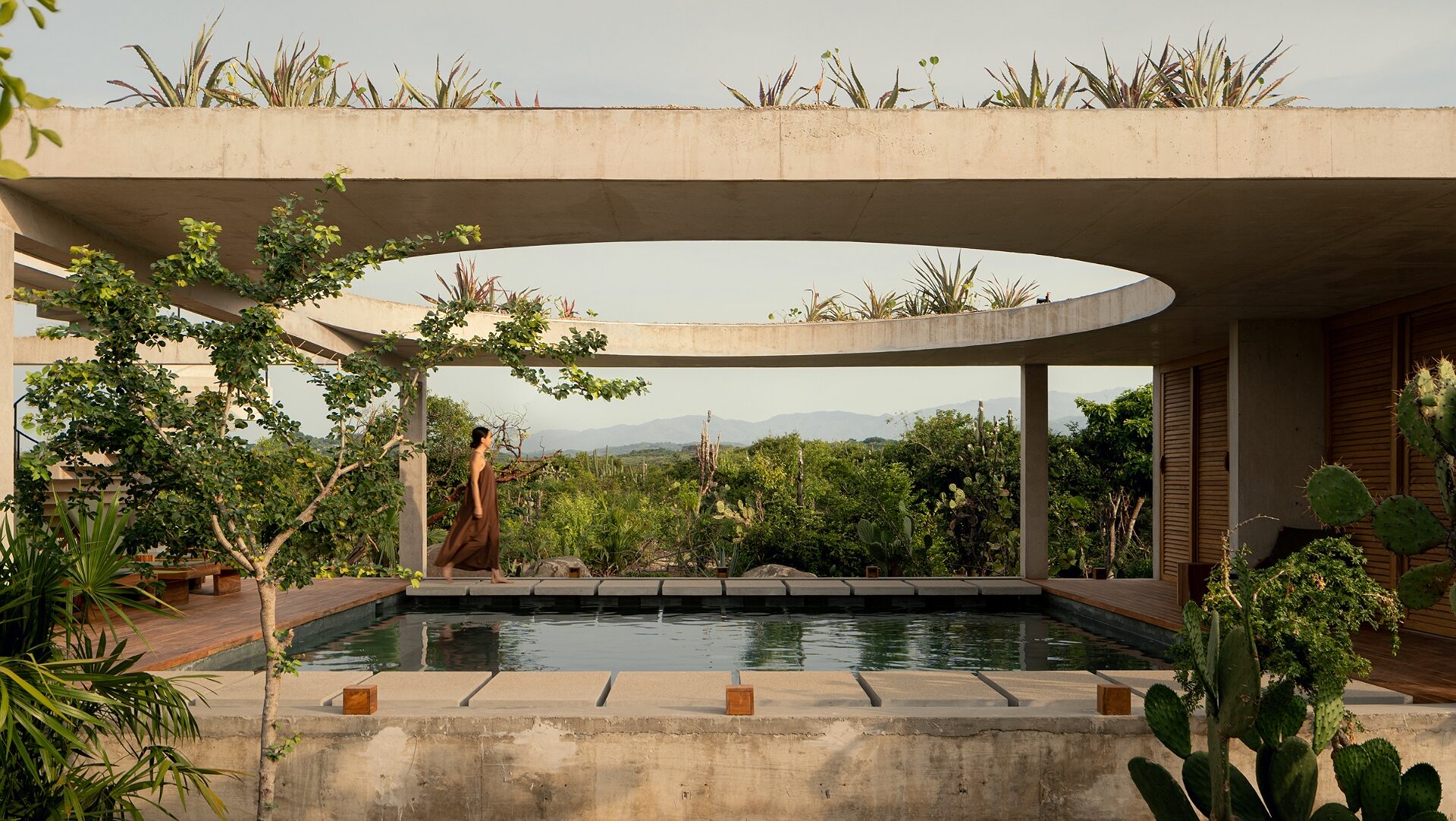
House 720 Degrees is a geometric and optical structure designed by Fernanda Canales that doubles the 360-degree track of normal vision. The design starts in a central patio and finishes in the surrounding landscape, connecting both worlds and inviting them to interact with each other.
Conceived as a solar clock that registers the passing of time, this off-the-grid house is many houses in one: during the day it frames a mountain and a volcano, opening up toward the varied views along the external perimeter of the circle; at night, it turns inward around the circular courtyard.


A circular house
The house is made of three different volumes: the main circular house, a detached studio/guest room, and a rectangular volume with a patio that contains additional bedrooms, storage, and services. The designer chose to divide the project into separate volumes due to the accentuated topography, as it allowed for the preservation of the existing vegetation.
The house covers two levels, one on the ground floor and another as an open roof terrace. While circular, all bedrooms, bathrooms, closets and the kitchen have a rectangular shape. The curved walls are left for circulation, extending as terraces toward the courtyard and as gardens toward the exterior. The designer used flexible openings (privacy screens, large fold-away windows and framed views) to transform the interior spaces and maintain a connection to the environment.


A thoughtful fit
Located in a secluded valley three hours from Mexico City, the house addresses two apparently contradictory conditions: seclusion and aperture. It shelters against radical weather, considering that temperatures here can vary by 30°C in a single day and rain dominates half the year, yet opens as much as possible to the surrounding landscape. Its walls act as membranes between two temperate zones (forest and prairie), two seasons (dry and wet) and three spatial conditions (centre, inside and outside).
The house is earthbound, nestling into the ground from which its materials emerge. To make the large-scale construction blend into the wild scenery, a low, single-level design with local soil mixed with concrete was used to achieve a natural finish. To upkeep the blend once inside, most of the lamps and furniture were produced on site with local materials and local craftsmanship, chosen by interior designer Camilla Pallares.


Independent and efficient
The house harvests rainwater, generates its own electricity through solar panels and incorporates hydronic radiant floors in the bedrooms. The solar system also heats water used throughout the house. Furthermore, every space benefits from natural cross-ventilation and opens to two or three different orientations.
The priority was easy and economical maintenance: durable materials that withstand the weather without painting or cladding, becoming part of the natural landscape. Built with the soil and colour of the land, the house changes subtly with the seasons, becoming a living structure that adapts, blends and breathes with its environment.


House 720 Degrees shows a different way of thinking about living in nature. Instead of standing apart from its surroundings, the house works with the land, the weather and the passing of time. Its circular form changes the way spaces are used throughout the day, offering wide views when the sun is high and a more sheltered atmosphere after dark. In the end, House 720 Degrees is about slowing down, paying attention to natural rhythms and experiencing the landscape as part of everyday life.
Source: v2com newswire